planEASe Software Version History
planEASe® is commercial real estate cash flow analysis software, developed continuously since 1982.
This page records every release, newest first, from the first versions in the 1980s through Version 25,
which brings planEASe to the web and to AI assistants.
Version 25 runs in your browser, opens your existing desktop files, and works with AI assistants that
support MCP, such as Claude. The Windows desktop version remains available and supported. Use the contents
below to jump to any version. Each entry lists what was added, and the older versions are kept here in full.
Contents
- Web + MCP
planEASe in your browser and with AI assistants. Nothing to install, and improved continuously: changes are added to the Version 25 page by date.
- November 2026 Version 25.00
(planEASe on the Web and with AI Assistants — reports, compare, portfolios, and more)
- Windows
planEASe for Windows, from the first Windows version in 1993 to today. It remains available and supported.
- May 2026 Version 24.01
(Secure HTTPS Cloud Connection — no more FTP)
- February 2012 Version 22
(Publish to Web and Financial Analysis)
-
February 2012 on - planEASe Cloud Version for Windows: a subscription that includes every new release
- February 2012 Version 21
(New Report Packages)
- February 2011 Version 20
(New Web Publication Service, New Watermarks when Printing, and more)
- January 2010 Version 19
(New Assumption EzEntry, Enhancements to Save as Web Page, and more)
- April 2009 Version 18
(Portfolio Extension)
- January 2008 Version 17
(Unit Sales Parameter: the Absorption Growth)
- January 2007 Version 16
(Conduit Loans / New Lease Up / planEASe Reader / Woven Training Movies)
- January 2006 Version 15
(Monthly/Quarterly/Yearly)
- January 2005 Version 14
(Spell Check / Thesaurus)
- January 2004 Version 12
(Tax Law + Market Profiles)
- January 2003 Version 11
(Reimbursements)
- October 2001 Version 10
(Development + Unit Sales)
- October 2000 Version 9
(Resize / Page SubTypes)
- October 1999 Version 8
(32 Bit / Web Pages)
- October 1998 Version 7
(TitlePages / Installment Sales)
- August 1997 Version 6.1
(1997 Capital Gain Law)
-
November 1996 Version 6
(Lease Analysis + Pie Charts)
-
November 1995 Version 5
(English Assumptions)
-
November 1993 Version 4
(First Windows Version)
- DOS
planEASe before Windows, 1981 to 1993.
-
April 1993 Version 3.33
(Publisher)
-
April 1992 Version 3.32
(Income Statements)
- December 1989 Version 3.2
-
September 1991 Version 3.31
(Reporting Extension)
- April 1991 Version 3.3
- May 1988 Version 3.1
-
November 1987 Version 3.0
(Point and shoot interface)
-
October 1986 Version 2.0
(1986 Tax Law)
- December 1985 Version 1.9
- December 1984 Version 1.8
- August 1984 Version 1.7
- November 1983 Version 1.6
- April 1983 Version 1.5
- December 1982 Version 1.4
- June 1982 Version 1.2
- December 1981 Version 1.0
planEASe Software Version 25.00 - Web + MCP
November 2026
Major item: planEASe on the Web and with AI Assistants (MCP)
V25.00 Enh - planEASe on the WebplanEASe now runs in your browser. Sign in, and your analyses are there on any computer, phone or tablet, with nothing to install and no Windows required. The same calculation engine that has powered planEASe since 1982 does the work, so a number you have relied on before is the number you will see here.
V25.00 Enh - Open Your Existing FilesUpload any of your desktop files (.ru or .rp) and planEASe makes a web copy; the original stays exactly as it was. The web engine was checked line by line against the desktop software on a large set of real customer files, and your analyses compute the same way. Pick the plan that covers the features a file uses: a file only calculates when everything in it is included in your plan, so you never see a partial answer.
V25.00 Enh - Works With Your AI Assistant (MCP)Connect an AI assistant that supports MCP, such as Claude, and it can list, read, create, change and calculate your planEASe analyses for you, then explain the results in plain words. Ask for a lease-versus-buy, a sale price sensitivity or a comparison of three buildings and the assistant builds and runs the analyses inside your own account. Everything you do by hand on the web, an assistant can do, and what one changes the other sees.
V25.00 Enh - The Assumptions Edit ScreenPages are in a tree on the left, with the Continue and Sub pages kept in order for you, so a lease with steps stays together and the screen only offers the buttons that make sense on the page you are on. Each assumption box shows its meaning in words when you are not typing in it (for example 1.5% of Property Price, 10 Years, Until Projected Sale) and shows the number when you click in, and the words follow your currency and area settings. Your changes are saved as you type. The (i) beside a field explains it in place, so there is little need to look anything up.
V25.00 Enh - Reports, PDFs and Shared LinksThe Proforma, the APOD, the annual statements and the sale reports are on screen, with a click on any year for its detail and a Rent Roll tab that shows each lease as of any period. A PDF of any report, or a package of several, is one button. A shared link gives your client a frozen copy of the analysis, calculated by the current engine, that you control: choose how much it shows, whether lease names are hidden, and when it expires. You can keep changing your own file and the link does not change until you update it.
V25.00 Enh - Sensitivity Analysis and Risk AnalysisPress the button beside any number to see how the results move when it moves: you give a start and a stop, planEASe runs five values and shows the table, a graph and a PDF. On a portfolio, the same button works on each of the portfolio's override assumptions. Risk Analysis (Monte Carlo) is included in the Advanced plan.
V25.00 Enh - Compare AnalysesPut two to six analyses side by side and vary one assumption the same way in all of them, for example the holding period, the sale price, the cap rate or the discount rate. You get one graph and table of the measure you care about, plain sentences saying which option is best and where the lines cross, a table of how the options differ, and a one-page PDF. It works for lease against lease, lease against buy, and one property in several scenarios, such as seller, normal and downside.
V25.00 Enh - Tenant Representation and Owner RepresentationA lease analysis is now part of the same system. Choose Tenant Rep or Owner Rep and the screen shows only what matters for the lease decision: months instead of years, payments entered as costs and receipts, and no vacancy. The results compare directly with your other analyses.
V25.00 Enh - PortfoliosA portfolio combines the live analyses of several properties into one report. Override assumptions apply to every property at once, for example one holding period, one acquisition date, or one set of partnership terms across the whole portfolio. Partnerships and LLCs run as one partnership over the properties. Change a property and the portfolio notices.
V25.00 Enh - Lease or Buy and Sale/LeasebackLease or Buy gives your client the answer in one page: the lease against the purchase, the point where they are the same, and the return earned on the savings. When there are more than two choices, Cost Compare builds one analysis per option with every cost inside it and shows where the options cross. Sale/Leaseback shows a seller what selling today and renting back gives up or gains, before tax and after tax, with the option of borrowing more against the building.
V25.00 Enh - Before Tax, After Tax, Currency and Square MetersAfter Tax is a view you switch on or off for each analysis. With it off, every screen, report, share and assistant answer is before tax only, which suits users outside the United States and anyone who only needs the before-tax picture. Analyses can be in any currency and measured in square feet or square meters.
V25.00 Enh - Plans and Free ToolsThree plans are available: Essential Analysis, Commercial Analysis and Advanced Investment, each including the one before it. Every plan includes the web screens, assistant access, shared analyses, PDF reports and graphs. The free tools (Loan Planner, IRR/NPV/MIRR calculator, Variable-Rate Amortization Schedule, 1031 Exchange Recap, Asset Depreciation Calculator and Interest Rate Comparisons) are available at planease.com/tools. Existing subscribers keep their current renewal price and receive the complete web and assistant system.
V25.00 Enh - The Windows Desktop VersionThe Windows desktop version remains available and supported for those who prefer it. Files move between the two: uploading creates a web copy, and a web analysis can be exported back to a desktop file, except for analyses measured in square meters, which the desktop cannot hold.
V25.00 - Fixes
Back to contents
planEASe Software Version 24.01
May 2026
Major item: Secure HTTPS Cloud Connection — no more FTP
V24.01 Enh - New HTTPS Cloud Connection — No More FTP
The most significant change in Version 24 is one you will feel immediately: the FTP connection
system has been replaced with a secure HTTPS connection. If you have ever had planEASe refuse
to connect at a hotel, a coffee shop, or inside a corporate network, that was the FTP system
running into a firewall. Port 21, which FTP uses, is routinely blocked by IT departments and
public networks. The new HTTPS connection uses Port 443 — the same port your web browser uses
— which is never blocked. It works everywhere: corporate networks, hotels, client offices, and
public Wi-Fi, with no IT calls, no port forwarding, and no firewall configuration required.
V24.01 Enh - Analysis Files Now Stored Locally
With Version 24, your analysis files live on your own computer or network rather than on
the planEASe server. This means faster file access, no server dependency for day-to-day work,
and full control over your own data. We recommend keeping a backup of your planEASe files
folder in case of computer changes or hardware failure.
For users of the Portfolio Extension, this change is particularly noticeable. Portfolio
analysis requires reading multiple files in rapid succession, and the previous FTP connection
was a bottleneck that slowed this down considerably. With files stored locally, speed should increase significantly.
If you have analysis files stored on the planEASe server from a previous version, they
remain available on your home page the moment you log in, ready to download to your computer
in one click.
V24.01 Enh - New Support Center
A new Support Center is now available at
planease.com/SupportCenter.aspx
the over 300 training videos are now indexed, making it easy to find answers quickly without
waiting for a callback.
V24.01 Enh - Installation and Access
The updated software may be installed on as many Windows computers as needed, however only one
session open at a time. planEASe also runs on Mac and other platforms using Windows
simulation software such as VMware Fusion or Parallels.
V24.01 - Fixes
Back to contents
planEASe Software Version 22.00
February 2012
Major item: 'Publish to Web' and Financial Analysis
V22.00 Enh - Financial Analysis Website Summary
Photo/Map, Description and Before Tax - The opening summary now only shows before tax information, and will show description and a map or photo if the information is provided. The photo will always be the first one in the photo list.
V22.00 Enh - Map Address during 'Publish to Web'
To make the quick and easy website more fulfilling the map address and description are now added on the same dialog as choosing the password during the 'Publish to Web' process rather than having go to the Web Publishing Center. The Map Address defaults to the address you entered for this analysis previously (if any). This address is used to obtain a map for the property, and should contain appropriate information to define the map, such as City / State / Zipcode. Alternatively, you may enter the Google Map Longitude / Latitude coordinates here. To obtain Google Map coordinates, right-click on the map location desired, choose "What's here" from the menu and copy the coordinates from the Google search box (for example: 41.879387,-87.625004).
V22.00 Enh - Summary Description during 'Publish to Web'
To make the quick and easy website more fulfilling a description that shows on the opening summary screen can now be added on the same dialog as choosing the password during the 'Publish to Web'. A full description can still be added with the title pages that gets it's own tab.
V22.00 Enh - Financial Analysis Website Printing
There is now a "Print View" that shows on almost all tabs when clicked, that will open the report shown in a new window in a print friendly format. For instance, if your customer clicks the Assumptions tab, the assumptions will show and the tab changes to Assumptions (print view). If your customer clicks the (print view) the assumptions report will open in a new windows in a print friendly format. Firefox, Chrome, and Internet Explorer have the best printing options.
V22.00 Enh - Financial Analysis Website GraphsOpening Graphs - The Opening Graph for investments and developments is 'Cash Flow Before Tax' with the IRR and Total Profit in the title. The Opening Graph for partnerships is 'Group Member Projection (per Unit)' with the IRR and Total Profit in the title.
Cash Flow Graphs - A new category of graphs is now shown that uses the data in the cash flow tab.
Partnership Cash Flow Graphs - A new category of graphs is now shown that uses the data in the partnership tab.
The proforma income graphs are now accessed by choosing the 'Graph Proforma Income' Menu item.
V22.00 Enh - Financial Analysis Website Cash Flow Tab
A new tab called "Cash Flow" now appears before the "Proforma Income" tab and contains the same information a the Basic Analysis Horizontal View. The title's 'Before Tax Cash Flow Projection', 'Taxable Income Projection', and 'After Tax Cash Flow Projection' are underlined in the report and bring up a dialog similar to the vertical view of the Basis Analysis, and if you have the monthly extension a monthly tab will be sown at the top. The "Print View" is available for all these reports. If you have turn off the after tax open in the proforma income statement before using the 'Publish to Web' this report will only be before tax.
V22.00 Enh - Financial Analysis Website Documents
At the Web Publishing Center there is a Documents button at the top that will enable you to add links to documents/websites with a title and description. The links can be to other sites, or you can upload .pdf documents to the planEASe site (10mb limit).
V22.00 Enh - Financial Analysis Website Photo Title and DescriptionName Change - At the Web Publishing Center the "Map & Photos" button has been replaced with a "Photos" button, becuase the map address and description are now part of the 'Publish to Web' process.
Link to Photo - Now upload your photos, and then link to them. This means if you have a photo that you want to use on many financial analysis websites you can upload it once and link to the same photo. Also, if you wan to have high resolution photos that you have on you own website you can link to those as well.
Title a Description - When you link to the photo you can add a title and description that will be displayed when your client click the photo.
V22.00 - Fixes
Back to contents
planEASe Software Version 21.03
February 2012
Major item: Report Packages
V21.00 Enh - New Report Packages
Have you ever wanted to just print a package of reports and graphs out of planEASe rather than printing each one at a time? Report Packages lets you do that and is a huge time saver! Create as many packages as you want with different names, then just choose one to print or save as a webpage (html file). It is that simple.
V21.00 Enh - Graphs added to - Web Publication Service
This service begins requires a current support subscription. Some of the reporting shown requires the Reporting Extension and Monthly Extension.
New Graphs
Click this link Commercial Office Development, and select the graphs tab on top to see all of the new graphs that your clients can be selecting from when viewing a published analysis on their browser.
The planEASe Web Publication Service is a simple-to-use system you can use to present your analysis over the web. After you have created your analysis, just select File / Publish to Web at the Assumption Edit Screen and e-mail your client the URL. It is that easy. Watch the video to see all the analysis and drill-down capability that is included with just this simple process. But if you would like to be fancier, we have included the capability to augment your presentation by adding your logos, specifying custom colors, adding extensive description text organized with tables, showing a interactive location map, and including any photos you choose. Click to view E-learning Topic ~ Web Publishing
V21.03 Enh - Financial Analysis Website Summary
Photo/Map, Description and Before Tax - The opening summary now only shows before tax information, and will show description and a map or photo if the information is provided. The photo will always be the first one in the photo list.
V21.03 Enh - Map Address during 'Publish to Web'
To make the quick and easy website more fulfilling the map address and description are now added on the same dialog as choosing the password during the 'Publish to Web' process rather than having go to the Web Publishing Center. The Map Address defaults to the address you entered for this analysis previously (if any). This address is used to obtain a map for the property, and should contain appropriate information to define the map, such as City / State / Zipcode. Alternatively, you may enter the Google Map Longitude / Latitude coordinates here. To obtain Google Map coordinates, right-click on the map location desired, choose "What's here" from the menu and copy the coordinates from the Google search box (for example: 41.879387,-87.625004).
V21.03 Enh - Summary Description during 'Publish to Web'
To make the quick and easy website more fulfilling a description that shows on the opening summary screen can now be added on the same dialog as choosing the password during the 'Publish to Web'. A full description can still be added with the title pages that gets it's own tab.
V21.03 Enh - Financial Analysis Website Printing
There is now a "Print View" that shows on almost all tabs when clicked, that will open the report shown in a new window in a print friendly format. For instance, if your customer clicks the Assumptions tab, the assumptions will show and the tab changes to Assumptions (print view). If your customer clicks the (print view) the assumptions report will open in a new windows in a print friendly format. Firefox, Chrome, and Internet Explorer have the best printing options.
V21.03 Enh - Financial Analysis Website GraphsOpening Graphs - The Opening Graph for investments and developments is 'Cash Flow Before Tax' with the IRR and Total Profit in the title. The Opening Graph for partnerships is 'Group Member Projection (per Unit)' with the IRR and Total Profit in the title.
Cash Flow Graphs - A new category of graphs is now shown that uses the data in the cash flow tab.
Partnership Cash Flow Graphs - A new category of graphs is now shown that uses the data in the partnership tab.
The proforma income graphs are now accessed by choosing the 'Graph Proforma Income' Menu item.
V21.03 Enh - Financial Analysis Website Cash Flow Tab
A new tab called "Cash Flow" now appears before the "Proforma Income" tab and contains the same information a the Basic Analysis Horizontal View. The title's 'Before Tax Cash Flow Projection', 'Taxable Income Projection', and 'After Tax Cash Flow Projection' are underlined in the report and bring up a dialog similar to the vertical view of the Basis Analysis, and if you have the monthly extension a monthly tab will be sown at the top. The "Print View" is available for all these reports. If you have turn off the after tax open in the proforma income statement before using the 'Publish to Web' this report will only be before tax.
V21.03 Enh - Financial Analysis Website Documents
At the Web Publishing Center there is a Documents button at the top that will enable you to add links to documents/websites with a title and description. The links can be to other sites, or you can upload .pdf documents to the planEASe site (10mb limit).
V21.03 Enh - Financial Analysis Website Photo Title and DescriptionName Change - At the Web Publishing Center the "Map & Photos" button has been replaced with a "Photos" button, becuase the map address and description are now part of the 'Publish to Web' process.
Link to Photo - Now upload your photos, and then link to them. This means if you have a photo that you want to use on many financial analysis websites you can upload it once and link to the same photo. Also, if you wan to have high resolution photos that you have on you own website you can link to those as well.
Title a Description - When you link to the photo you can add a title and description that will be displayed when your client click the photo.
V21.00 - Fixes
Back to contents
planEASe Software Version 20.00
February 2011
Major new items are: New Web Publication Service, New Watermarks when Printing, and more
V20.00 Enh - New planEASe Web Publication Service
This service begins with Version 20 of planEASe and requires a current support subscription. Some of the reporting shown requires the Reporting Extension and Monthly Extension.
The planEASe Web Publication Service is a simple-to-use system you can use to present your analysis over the web. After you have created your analysis, just select File / Publish to Web at the Assumption Edit Screen and e-mail your client the URL. It is that easy. Watch the video to see all the analysis and drill-down capability that is included with just this simple process. But if you would like to be fancier, we have included the capability to augment your presentation by adding your logos, specifying custom colors, adding extensive description text organized with tables, showing a interactive location map, and including any photos you choose.
Web Publication Service Detail
With the planEASe Web Publication Service, a lot can be done in just a few clicks, just using the default settings. Within 10 seconds, your analysis can be uploaded to the web with extensive reports (APOD, Comparative APOD, Income Statement, Lease Analyses, Annual Statements and Assumptions Report) . This movie shows the uploading process in real time.
planEASe Version 20 includes a greatly improved TitlePages Word Processor at Reports / TitlePages, with enhanced image capabilities, and greatly enhanced tables that allow tables within tables. The planEASe Web Publication Service uses this word processor to create, format and save the description text for your Web Published Analysis. Any text you create can and should be saved with the Assumption Set so future publications will retain the text. This short movie gives you an idea of some of the formatting capabilities of TitlePages.
The look of the planEASe Web Publication Service is controlled through styles. A style consists of the colors you choose for the backgrounds, the font you choose for the text, a photo to be displayed with your contact information, and two logos to be displayed with your analysis information. While we anticipate that most users will simply specify one (default) style, you can enter as many styles as you want; and choose which of your styles should be used for each analysis. This movie gives you a brief look at how you would specify and/or change a style.
You can add an interactive Google map and some photos to your analysis for presentation purposes. Because you typically will reload an analysis several times, but will not want to reload the map and pictures, we link them to the address you enter for the APOD location field in planEASe. This means that, if the location field stays the same, the map and photos you entered for an analysis will stay with the reloaded analysis. This movie shows you the simple process for loading photos and the Google map for an analysis. Of course, if you choose not to enter a map or photos, the associated tabs will not be shown during your presentation.
planEASe Web Publication Control Center
Each planEASe License with a current support subscription has its own Web Publication Control Center where the Web Published Analyses for that license are listed and maintained. You may access your Web Publication Control Center by logging into the planEASe Website and clicking on the Go To Web Publication Control Center link located at the top left of your user home page.
There are three areas in the Web Publication Control Center-
Web Pub List
Lists all the web publications for the license
(Delete analyses, change passwords, choose styles here)
-
Styles
Add and customize your styles here
-
Maps & Photos
Add maps and/or photos that link to your web publications
* Videos were made using a planEASe license with all extensions.
V20.00 Enh -
Watermark
We have added a Watermark Dialog, accessible from the Page Setup Dialog. The
Watermark Dialog allows you to choose a graphics file that will print under the
middle of all planEASe Reports, thus allowing you to further brand your planEASe
output. Watermarks may be sized from 100% of the width of the Report to 5% of
the width.
V20.00 Enh -
Spelling with all multi-line textboxes
The Spelling and Thesaurus capabilities in Reports / TitlePages have been extended to operate with all multi-line textboxes throughout planEASe. An example of a multi-line textbox is the Report Commentary textbox in the Print Options dialog presented whenever you print a planEASe report or graph. When you have such a textbox presented to you, doubleclicking on any word pops up a menu with either suggested replacements from the built-in Dictionary (if the word is misspelled) or suggested synonyms from the built-in Thesaurus (if the word is properly spelled). Choosing the SpellCheck option on the popup menu checks the spelling for the entire text in the textbox. During the SpellCheck, you can Add new words to your personal Custom Dictionary, Select a replacement word from the suggested list, Change All occurrences of a word, or Ignore All occurrences of a word.
For consistency, the Spelling and Thesaurus capability in Reports / TitlePages has been changed to operate in the same fashion.
In the Print Options dialog, doubleclicking in the Report Commentary textbox previously brought up a dialog where you could cut, copy and paste text to and from the Report Commentary and the Assumption Set Comments. This function has now been moved to the new TransferComment menu option in the Print Options dialog.
V20.00 Enh - Reports / TitlePages
The Word Processor at Reports / TitlePages has undergone a major revision, with
many enhancements:
- File Open / Save As routines have been combined into single dialogs for all file
types.
-
We have added Open and Save As capability for Microsoft Word (*.doc) files,
making it easier to incorporate information from these files in your TitlePages
Documents.
-
The Table capability has major enhancements, including drag/drop setting of
column and table widths and location, together with a new Table Properties
... menu option for setting fore and back colors, etc.
-
The dialog at Format / Image... has many more capabilities, and the error when
accessing it without previously selecting the image has been eliminated.
-
New Menu options at Insert / Frame and Format / Frame... allow you to insert
and format frames that can contain either text or images. An example of this
new capability is in the revised capable.txp file shipped with planEASe.
-
Major new expansion of the Edit / Undo and Edit / Redo menu option
capability allows for many levels of undo and redo, and they are constantly retitled
to show what is being undone and redone.
V20.00 Enh -
Save as Web Pages now Paginated
The reports and graphs available throughout planEASe at the Print / Save as Web Page Menu Option have been dramatically improved in two ways. First, the HTML files (Web Pages are HTML Files) have been reduced in size by two-thirds. This means they are created faster, load into your browser faster, e-mail faster, and take less space on your disk. Second, the reports are now paginated. Just like the multi-page reports planEASe has always produced on your printer, the WebPage reports are now divided into the same pages, and can be printed handsomely from your (or your client’s) browser. These changes have been tested with the latest versions of Internet Explorer, Firefox, Safari, and Google Chrome.
V20.02 Enh -
Increased font size for printed graphs and charts
We have slightly increased the font size for printed graphs and charts to enhance readability. Thanks to Skip Duemeland, CCIM for the suggestion.
V20.03 Enh -
Risk Analysis
When running Risk Analysis with planEASe expanded to full screen, the Risk Analysis Assumptions Grid (the one at screen top) resized improperly, causing the fields in the leftmost column to be too small for proper display or data entry. Introduced in version 20 and fixed in version 20.03 Thanks to Skip Duemeland, CCIM for the report.
V20.03 Enh -
Assumptions Report
The Assumptions Reports (at File / Print Assumptions and at Reports / Assumptions Report) have been changed to eliminate printing of Reimbursements and /or Percentage Rents assumptions. Instead, when such assumptions are present in an Assumption Set, the commentary text in the Print Options Dialog contains “The Reimbursements and/or Percentage Rent Assumptions for this Assumption Set are reported separately.”, allowing you to reference the Reimbursements Assumptions report available at Edit / Reimbursements / Print / Print.
V20.00 - Fixes-
The new Clone Profile capability at Edit/Market Profiles introduced in version 19 inadvertently allowed cloning Variant Profiles, which is (now) not allowed.
-
The Delete Profile capability at Edit/Market Profiles did not work properly.
-
In the Unit Sales and Development Spending Dialogs, the routine to delete measure names from the dropdown list (after new measures have been added) did work properly in some cases.
-
The demo-reader program inadvertently did not allow access to Portfolio Mode (at File / Portfolios...) Intentionally, you still cannot access Portfolio Mode if you are viewing a Reader File sent by a planEASe User.
V20.01 - Fixes-
When exiting the Reimbursements Dialog, a Type Mismatch error causes planEASe to halt. Thanks to Greg Ogin, CCIM for the report. Introduced in version 20 and fixed in version 20.01
-
When changing the current Assumption Page by using the keys rather than clicking on the Page List, the two line Assumption Help message at the bottom of the Assumption Page did not update properly. Introduced in version 20 and fixed in version 20.01
-
On entering the Unit Sales Dialog, the Edit menu did not initialize properly to the actions allowed for the Unit Type Grid. This was a long-standing bug, discovered in version 20 and fixed in version 20.01
V20.02 - Fixes-
Some users had trouble uploading their first published analysis. This occurred when the last Assumption Set saved or opened was in a different folder than the folder where planEASe is installed (typically c:/planwin). Introduced in version 20 and fixed in version 20.02
V20.03 - Fixes-
The APOD mistakenly used the second month of the Holding Period as the computational base rather than the first month. Introduced in version 15 and fixed in version 20.03 Thanks to Ron Bowden, CCIM for the report.
-
If a Market Profile had a 0% Renewal Probability, the Assumptions Report did not include the General Assumptions for that Market Profile. Thanks to Geoffrey Taylor for the report.
-
When using the new File / Publish to Web capability with a partnership analysis, planEASe would hang up if the Income Statement Show NPV’s option was chosen (even though NPV is not available with the partnership income statements). This made not available when viewing partnership income statements. Thanks to Craig Blorstad CCIM, CPA for the report. Introduced in version 20 and fixed in version 20.03
-
The Assumptions Report at File / Print Assumptions erroneously showed “Annual at $0.00 per year” instead of “Annual at the Inflation Rate” for Revenues and Expenses planned to grow at the Inflation Rate. Introduced in version 20 and fixed in version 20.03. Thanks to Brian Velthoen, CCIM for the report.
Back to contents
planEASe Software Version 19.00
January 2010
Major new items are: New Assumption EzEntry, Enhancements to Save as Web Page, and more
New Assumption EzEntry
V19.00 Enh - Assumption EzEntry Dialog
A new Assumption EzEntry Dialog is accessed from the File / New Assumptions Menu Option, filling in the SqFt or Units entry in the Assumption Set Specification Dialog, and pressing the (new) EzEntry Button that is activated by your SqFt or Units entry. This Dialog provides a fast and convenient method of entering starting Assumption Values for an Assumption Set by allowing pasting of entire columns of information supplied from an external Rent Roll, APOD, or other information source for a property, saving substantial time in entering new Assumption Sets for properties, and avoiding typing errors for such items as Tenant Names, Rentable Square Feet, Rental Rates, et cetera.
V19.00 Enh - Dialog Help Messages
In the new Assumption EzEntry Dialog, every time you move to a Cell in one of the Grids, there is a Help message shown in the left side of the Status Bar below the Dialog describing how to enter data in the Cell. We have used this new technique to post similar Help messages while you are in the Grids in the Development Spending, Unit Sales, Reimbursements, and Market Profiles Dialogs.
V19.00 Enh - Development Dialogs
The PasteColumn Menu Option in the new Assumption EzEntry Dialog described above has been added to the Development Spending & Unit Sales Dialogs, allowing rapid entry of Item Names, Quantities and Costs when you have a external Bill of Materials for a development.
V19.00 Enh - Undo capability in EzEntry and Development Dialogs
Because the PasteColumn Menu Option can, if used in error, cause mistakes that would require much time to correct, we have installed an Edit/Undo capability in new Assumption EzEntry Dialog and the Development Spending & Unit Sales Dialogs. This Undo capability will Undo all PasteColumn Commands, Edit / Cut / Paste / Insert / Delete Commands and Sort Commands, in reverse order of incurrence, and without limit.
Enhancements to Save as Web Page
V19.00 Enh - Save as Web Page
All reports available at the Save as Web Page menu option have been dramatically improved in format to take advantage of the Cascading Style Sheets language being further implemented by the major browsers. The planEASe webpages now appear with the information in boxes much like the printed reports. Colors and fonts now correspond to the treatment in the printed reports, as defined in the Page Setup menu option. This improvement has been tested with the current versions of Internet Explorer, Mozilla Firefox, and Apple Safari. As before, you may E-Mail these Web Page reports directly to your clients for viewing in their browsers.
V19.00 Enh - New Method for Emailing Web Pages with Graphs/Pie Charts
***This method will work with planEASe Version 8 and greater ***
If you use Microsoft Internet Explorer and Microsoft Outlook 2000 or greater you can email the planEASe webpages with graphs by changing an option in Microsoft Outlook. Here's how:
Open Microsoft Outlook-
On the Tools menu, click Options, and then click the Mail Format tab.
-
Click to select HTML in the "Send in this message format" list, and then click OK.
-
Click the Settings button, check the Send Pictures from the Internet, and then click OK.
-
Then click OK
Open planEASe-
Use the Save as Webpage menu option to save and append as many graphs as you want
-
Open the webpage in Internet Explorer (If Internet Explorer is your default browser, select the View Webpage menu option in planEASe and the webpage will open in Internet Explorer automatically).
With the Webpage open in Internet Explorer-
Select File/Send > Page by Email.
Now the Webpage should be in an Outlook Email with Pictures.- The webpage with all the planEASe Graphs/Pie Charts embedded is ready for more comments, spell checking, and, of course, sending.
* Note - The previous method for the Emailing Web Pages with Graphs/Pie Charts used Microsoft Word and the Break Links option in Word, which is not necessary with this new method for Emailing Web Pages with Graphs/Pie Charts.
V19.00 Enh - "Save as Web Page" reports are now Print-Friendly
Recent changes to Cascading Style Sheets now implemented in browsers enable print page breaks to be recognized. While the webpages won't print perfectly like they do from the printing mechanism within planEASe, the output is almost as good for 80% of what you will likely print. To have the colors show up on the printed page, you will have to turn on the print background option in the browser. Here's how:
Internet Explorer-
Select File/Page Setup then check Print Background Colors and Images
Mozilla Firefox-
Select File/Page Setup then check Print Background (Colors & Images)
Apple Safari-
We cannot find a capability to print Background Colors in this browser
V19.00 Enh - Lease Analysis
In Lease Analysis, we have added a new preference choice at Print / Preferences. The new Adjust $/RSF & $/USF for Partial Periods preference (checked by default) adjusts the rate for a 6-month year of $10,000 for 500 SF from $20/sf to $40/sf, allowing easier comparison to the following (full) year. Turned off, this rate will now show as $20/sf. Thanks to Stuart Simek for showing us a situation where this new treatment was appropriate and desirable. We also have inserted “X Months” in the Grid header for partial periods to clarify the report.
V19.00 Enh - Clone Market Profile
We have added a Clone Profile button to the Market Profiles Dialog, allowing you to easily copy the Current (highlighted) Profile. This makes it easier to replicate existing profile patterns when you only have minor changes to what has been entered for an existing profile.
V19.00 Enh - Lease Analysis
At the request of several users, we have added another new preference choice in Lease Analysis. The new Show Average Gross as: preference allows you to choose Monthly or Annual rate for the Average Gross (or Average Effective if you are using the Vacancy Factor). The Graphs available for the Summary Grid have been changed to reflect this preference as well. For instance, the Annual Lease $ Comparison Graph becomes the Monthly Lease $ Comparison Graph if the Monthly preference has been chosen.
V19.00 Enh - Lease Analysis and Rent Roll Reports
The Sort capability in both Lease Analysis and the Rent Roll Reports has been updated to operate in the same way as in the new Assumption EzEntry Dialog, so when requesting a sort, you may choose Ascending or Descending order (or simply Cancel and return to the unchanged Grid).
V19.00 Enh - Rent Roll Report
The Start and End Date columns for the Rent Roll Report have been reformatted to a “1 mmm yy” format both for clarity and to assure that, when exported to Excel (and other Spreadsheets), the contents will be interpreted as dates."
V19.00 - Fixes-
If you changed the Acquisition Date for a Development Spending or Unit Sales Assumption Date to be ahead of (or too close to) the earliest development cost item, planEASe (correctly) changed the Acquisition Date to be one month before that cost, but if you then (before requesting another function, such as Basic Analysis) navigated to any page requiring an audit, an unrecoverable error occurred. Introduced in version 17 and fixed in version 19. Thanks to Scott Hyatt for the report.
-
In Lease Analysis, printing of the analysis in monthly landscape mode could, in some instances, omit printing the last page. Thanks to Todd Silverman for the report.
Back to contents
planEASe Software Version 18.00
April 2009
Major new item is: Portfolio Extension
V18.00 Enh - Portfolio Extension
This Version 18 features the introduction of the Portfolio Extension to the planEASe Product Line. The Portfolio Extension allows you to perform analysis that otherwise would be impossible or impractical. For instance, with the Portfolio Extension, you can analyze and report on:
-
Multi-Phase Unit Sales Development Projects
-
Multi-Phase Commercial Developments
-
Mixed-Use Development Projects
-
Purchase of any type of Mixed-Use Property
-
Annual Projection Reports for Client Property Portfolios
-
Properties with multiple Reimbursement Pools
-
Multi-Property Portfolios offered for Purchase / Sale
-
A Partnership / LLC for any or all of the above:
We hope you will enjoy using and profiting from this remarkable new capability.
V18.00 Enh - Sensitivity and Risk Analysis
From the beginning of planEASe, we have accepted invalid Starting and Stopping assumption values in Sensitivity and Risk Analysis specifications, relying on user common sense. With the issuance of the Portfolios Extension there are occasions where mistakes are too easy to make. Therefore, in Sensitivity and Risk Analysis in version 18 we have installed the same edits as at the Assumption Edit Screen. For example, if you choose Capital Gain Rate as the Sensitivity Assumption and specify a Starting at of 200, you will be told that the rate must be between 0 and 100, just as when first entering the assumption value at the Assumption Edit Screen.
V18.00 Enh - Portfolios Extension
Prior to the introduction of the Portfolios Extension, we edited the Acquisition Date and Holding Period for Assumption Sets using the Unit Sales or Development Spending Dialogs so that all Development Costs and all Unit Sales would occur within the Holding Period, and you were notified when the Acquisition Date or Holding Period was changed for this reason. For Unit Sales Assumption Sets, the Sale Proceeds and Measures (IRR and NPV) Sections of the Income and Annual Statements were not available (because these sections simulate a Sale at the end of the year, thereby cutting off sales of units beyond that time and distorting any NPV or IRR measures that would be shown).
The Portfolios Extension complicates this situation, since a Portfolio may well include several development Assumption Sets together with non-development Assumption Sets (with a longer Holding Period than the development(s) require). Therefore, for such Portfolios, planEASe remembers the minimum Holding Period required for the development Assumption Sets, and notifies of changes in the Acquisition Date and Holding Period prior to computations in all cases. For the Income and Annual Statements, the Sales Proceeds and Measures Sections are shown for all years ending after the minimum Holding Period.
V18.00 Enh - planEASe Manual, fully bookmarked
As with version 17, the planEASe Manual, fully bookmarked and linked, is available within planEASe at the Help / planEASe PDF Manual Menu Option. For this reason we have ceased shipping new manuals with the annual updates in favor of opening a new planEASe Manual Store where you may order a current (now version 18) planEASe Manual for (currently) $25 plus shipping. To order your new manual, if you want, go to our site, sign in, and click on Order Version 18 Manual there.
V18.00 Enh - Unit Sales Partnership / LLCs
Several Users have pointed out that Unit Sales Partnership / LLCs distributions can cause assessments or GP/Manager loans due to draw loan repayments causing negative cash flows in the month following large sales. To fix this, starting with version 18, planEASe looks forward one month when distributing cash, and reserves enough to pay any negative cash flow scheduled to occur then.
V18.00 - Fixes-
The new Absorption Schedule Stretcher worked properly when stretching the Schedule(s), but did not work properly when contracting them in time. Introduced in version 17.00 and fixed in version 18. Thanks to Ira Bennett for the report.
-
Investment Tax Credits were not reflected in the Cash on Cash After Tax, Accounting RoR After Tax and Current RoR After Tax ratios in the Proforma Income and Annual Statements. Introduced in version 16 and fixed in version 18. Thanks to Mike Shaffer, CCIM for the report.
-
The open routine for backup assumptions used when an error caused abnormal termination of planEASe was inadvertently bypassed in version 17. It now works correctly in version 18.
-
The Unit Sales Profit Report did not include Sales Detail for the sales planned by the new Absorption Method. Additionally, the Unit Sales per Month Assumption was omitted from the Assumptions Report. Introduced in version 17 and fixed in version 18. Thanks to Michael George for the report.
-
When using the RP Model Series together with a Sale Price Method of either Capitalize Last Year’s NOI or Capitalize Next Year’s NOI, certain Partnership / LLC Fees could be shown in the Income and Annual Statements. Introduced in version 17 and fixed in version 18.
Back to contents
planEASe Software Version 17
January 2008
Major new items are in the Unit Sales Development Absorption Growth Area .
V17.00 Enh - Unit Sales
We have made several expansions and improvements in the Unit Sales capability. First, we have added the ability to plan Unit Sales by the Absorption Method in addition to the current Discrete Method. When you enter the Unit Sales Dialog for the first time, your sale plan for each Unit Type will now default to the Absorption Method (if you want to plan sales for this Unit Type by the previous Discrete Method, just click on the new Discrete CheckBox in the Unit Grid and the previous Discrete Method grid will appear for your editing pleasure). The Absorption Method Grid asks for the following Assumption Values for a Unit Type:
-
Unit Price
-
Total Units to be Sold
-
Unit Sale Start Date
-
Unit Sale Growth Rate
-
Units Sold per Month
-
Unit Standard Cost
-
Unit Sale Cost
Unit Sale Growth Rate allows the Unit Price to inflate at a specified rate unique to this Unit Type. Units Sold per Month can be fractional (eg: 2.54 per month would result in a forecast of 2, 3, 2, 3, 2, units, etc until the Total Units to be Sold amount is reached. Upon leaving the Unit Sales Dialog, these assumptions are saved in a new rev-usa Page Type (one per Unit Type), and therefore are available to you in Sensitivity and Risk Analysis.
V17.00 Enh - Unit Sale Dialog
We have changed all the Reports in the Unit Sale Dialog so that the numbers now reflect the values on the Unit Sales Parameters (rev-usp) Page, just as the reports in planEASe itself always have. This means that all reporting now agrees, even when the Parameter Page assumption values have been changed from the defaults. To alert you to the effects of non-default Parameter values, when reports are affected, the title bar caption is changed to show “Reports reflect Non-Default Parameters” and the default Report Commentary shown when printing reports shows the status of all non-default Parameters. Additionally, when processing reports for a Unit Sales Assumption Set using Non-Default Parameters in planEASe itself (NOT in the Unit Sales Dialog), the default Report Commentary has been adapted to show the status of all non-default Parameters.
V17.00 Enh - Unit Sales
You may now edit all Unit Sales Parameter Assumption values within the Unit Sales Dialog by accessing the new menu choice:
Edit/Edit Parameters ...
V17.00 Enh - Unit Sales
We have added a new Unit Sales Parameter: the Parameter Application Offset. This value, measured in Months from the Date of Acquisition, negates application of any Parameter Values (Price and Cost Multipliers as well as Price and Cost Inflation, but excepting the Absorption Schedule Stretcher described below) for all Sales and Costs occurring before the named number of months after Acquisition. This facilitates posting (and maintaining) actual costs and sales and only applying Parameters to costs and sales scheduled for the future.
V17.00 Enh - Unit Sales
We have added another new Unit Sales Parameter: the Absorption Growth Override, which may be set to Yes or No. If set to Yes, the Unit Sale Growth Rate for all Units planned by the Absorption Method will be ignored, and the Price Inflation Rate Parameter Value will be used instead. This allows you to apply the Price Inflation Rate to all future sales, whether planned by the Absorption Method or the Discrete Method, which may well be useful in Sensitivity and Risk Analysis.
V17.00 Enh - Unit Sales
We have added yet another new Unit Sales Parameter: the Absorption Schedule Stretcher, which allows you to stretch (or contract) the schedule for all Unit Sales planned by the new Absorption Method. You can do this for individual Unit Types by changing the Units Sold per Month on the Unit Sales Revenue Page (Absorption), but this Parameter varies ALL Absorption Sale Schedules at the same time. Entering 10 here means that all Absorption Schedules will be 10% longer in time, while minus 20 means they will be 20% shorter than specified. The actual calculation involves planEASe changing the Units Sold per Month by the entered percentage for each Unit Type. Thus an entry of 50% Longer would cause a Units Sold per Month of 2.54 to be computed as 2.54/1.5 or 1.69 Units Sold per Month. The maximum stretch allowed is 200%, and the maximum contraction is 50%. This Parameter applies from the beginning of the Absorption Schedule(s) no matter what the Parameter Application Offset value is.
Whether you are using the Absorption Schedule Stretcher or not, if you are performing a Unit Sales Analysis, planEASe in version 17 and following will automatically stretch the Holding Period and adjust the Date of Acquisition to assure that all scheduled sales and costs will occur within the Holding Period. If these adjustment(s) occur within the Unit Sales Dialog or during calculations of an Audit, Detail or Basic Analysis, you are notified of the adjustments by a status message and the actual Assumption Values are changed at the Assumption Edit Screen. If the adjustment(s) occur during Sensitivity or Risk Analysis, they occur without notice, and the original values are restored following the Analysis.
V17.00 Enh - Development Spending
We have added a Project Draw Loan Report to the Reports Menu in the Development Spending Dialog.
V17.00 Enh - Development Spending
We have added the Interest Cost for the Draw Loan to the Project Cost Summary Report in the Development Spending Dialog.
V17.00 Enh - Development Spending
We have eliminated the File Open/Save Capability within the Development Spending and Unit Sales Dialogs because it was redundant with the ability to open and save Assumption Sets.
V17.00 Enh - Partnership/LLC Models
We have made all reports on the Reports Menu available when using the Partnership/LLC Models , so you will no longer have to Convert Assumptions back to the RU Series to get Income Statements. Affected reports now have a Report Commentary warning that the report has not been adapted for the effects of Group Investments, and the tax section of the Income and Annual Statements is not available when using the Partnership/LLC Models.
V17.00 Enh - planEASe Help System
The planEASe Help System has received a major update making it completely compatible with Vista, providing improved Help and new navigation capability.
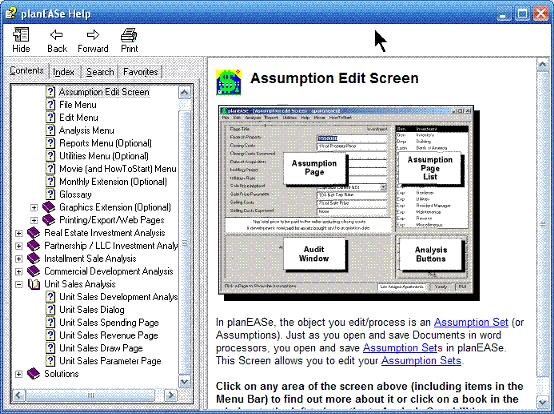
This what it looks like in Version 17 when you press "F1" at the Assumption Edit Screen. Note the Tree Structure on the left side of the window, allowing you to quickly access any area of the help. Click on the Index tab above and a huge index file allows you to look up virtually any reference you want. All areas of planEASe Help work as before, only better ... MUCH better.
V17.00 Enh - planEASe Manual
As with previous updates, a new Version 17 planEASe Manual is included, and a PDF version of the manual is installed at Start /All Programs /planEASe /planEASe Manual. For the last two versions, the PDF has been bookmarked for fast and easy access to individual manual sections. This year the bookmarks continue, and we have added links for even easier navigation within the document.
To use these links successfully, you should modify your Acrobat Reader toolbar to add buttons for Previous View (back) and Next View. Within the Reader, choose Tools / Customize Toolbars... and scroll down to the Page Navigation Toolbar area. Ensure that it is checked, and then check the Previous View and Next View Icons to add them to your toolbar. Now you're all set to skip about in our documentation.
In version 17, you also can access the PDF Manual from the Help Menu with the new Menu Option Help / planEASe PDF Manual which automatically brings up the linked and bookmarked Manual in the Acrobat Reader.
V17.01 Enh - Unit Sales Absorption Sales
The input routines for the new Unit Sales Absorption Sales grid in the Unit Sales Dialog have been revised to be more in line with the other grid input routines in planEASe.
V17.01 Enh - Unit Sales Draw Loan Report
Formatting for the Unit Sales Draw Loan Report and the new Construction Draw Loan Report has been improved, eliminating printing of $0 amounts and, for the Unit Sales Draw, shortening the report to eliminate trailing months when they are irrelevant.
V17.01 Enh - Help File
We have expanded the new Help File shipped with Version 17 to include a complete new section on Owner / User Analysis (this includes Tenant Rep, Owner Rep, Lease/Purchase, Sale/Leaseback and Cost Comparison subsections). Additionally, the Introduction Sections for all analysis functions now include links to the relevant WebSite Sample Reports and Movies, and the Index now includes Sample Movie and Sample Report items so you can go directly to the Movie and Sample Reports that you want to see. Try it .... You’ll like it !!
V17.00 - Fixes-
If you entered Sale Costs of more than 100 (so it was interpreted as a dollar amount rather than a percentage), the Cost of Sale in the Sale Proceeds area of the Income and Annual Statements was 12 times the entered amount. No other amounts or calculations were affected. Introduced in version 15 and fixed in version 17. Thanks to Jim Campney, CCIM
-
If you used Continuation Pages or SubPages in planning Expenses, then reimbursed those Expenses for some or all leases, set planEASe to view reimbursements separately at File/Preferences, and then asked for Reimbursement Details for the Income Statements, Annual Statements, APOD or Detail Revenues, the Expense Titles were wrong. Introduced in version 15 and fixed in version 17.
-
If you had Passive Losses, and chose to carry them forward, the amount shown the the Income and Annual Statements in the (Cum Suspended Losses) line was wrong. This line is simply an information line and does not affect any measures or other information. Introduced in version 15 and fixed in version 17. Thanks to Mark VanArk, CCIM
-
Some Assumed Loans with Continuation Pages did not compute correctly, placing the continuation steps wrongly in the future. Introduced in version 16 and fixed in version 17.
-
When using the new Unit Sales Absorption Sales capability, the Gross Income Line in the ProForma Income Statements and Annual Statements did not compute correctly, but all other lines below Gross Income (including Effective Income) were correct. Introduced in version 17 and fixed in version 17.01.
-
If you used a zero value for Units Sold per Month together with a positive Unit Sold value in the new Unit Sales Absorption Grid, planEASe would hang up. We have changed the edit for this field to accept only positive values. Introduced in version 17 and fixed in version 17.01.
-
If your Unit Sales Absorption Sales ended in the last month of the Holding Period, planEASe would erroneously increase the Holding Period from X years to X years rather than to X+1 years. Introduced in version 17 and fixed in version 17.01. Thanks to Roy Hanlin, CCIM CPM for the report.
-
For the new Construction Draw Loan Report, the “Draw every X months” field did not work properly for X not equal 1 month. Introduced in version 17 and fixed in version 17.01.
-
The routine for an assumed loan with a Continuation Page starting after the Acquisition Date did not place the continuation properly in time. Thanks to Lester Ip for the report. Introduced in version 17 and fixed in version 17.01.
-
If you opened a Reader File (in either the Demo-Reader or planEASe itself) and then exited planEASe while still viewing the Reader File, it was possible that several of your preferences could be changed to those of the person creating the Reader File. Introduced in version 16.01 and fixed in version 17.01.
Back to contents
planEASe Software Version 16
January 2007
Major new items are: 'Graph Library', 360/365 Conduit Loans, Multiple Market Profiles/Lease, New Lease-Up Capabilities.
V16.00 Enh -
Graph Library
We have added a Graph Library in the Reports/Income Statements function. This new Graph Library allows you to recall and save Graph Specifications for Graphs of your choice using the new Adds and Overlay Lists added in Version 15.
Graph Specifications that you save are valid, and may be used/opened, regardless of the current settings for the Period Menu (Yearly / Quarterly / Monthly) and regardless of the View Setting (ProForma / Common Size / SqFt/Unit). This capability allows you to save literally millions of graphs of your own design for future recall and production with any of your analyses. The Graph Specifications saved include the current settings for the graph controls (Font, for instance) at the time of the save, so recalled graphs will appear as they were when saved, rather than being configured to current control settings.
A Remarks text box is shown at the screen bottom right (overwriting the Report View box) when you open a Graph Specification, and showing the remarks entered the last time you saved the recovered graph. You may save whatever text you want here, and it is presented as the default Graph Commentary in the Graph Print Options Dialog Box.
The Graph shown when you open a specification will agree with the current values for the Period Menu and View Setting, and the data shown in the graph will agree with the current data shown in the report specified by these controls. Therefore, if you open a graph which calls for (and shows, for instance) the Cash on Cash Before Tax Ratio, that ratio must be shown in the report currently specified (and shown), or you will receive an Error Message telling you that the data cannot be found, and the graph to be opened cannot be produced.
The Graph Specifications that you save use the Line Title (for instance "Cash on Cash Before Tax") to find the data to produce in your graph. Editing these Line Titles will cause the loaded Graph Specification to be unable to find the required data, causing an Error Message unless you edit the Line Title in the current report accordingly. We suggest you avoid editing Line Titles if you want to use the Graph Library.
We ship planEASe with a small library of Graph Specifications you may want to use for your analyses. To distinguish between our graphs and those you may want to add yourself, all our Graph Specification files begin with the letters "pe". Beyond that, we add, for example:
-
pe_us_pf for Unit Sales Graphs preferring the ProForma view
-
pe_ia_cs for Investment Analysis Graphs preferring the Common Size view
-
pe_ds_sf for Development Spending Graphs preferring the Unit/SqFt view
V16.00 Enh - Graph Specifications
Graph Specifications that you save are valid, and may be used/opened, regardless of the current settings for the Period Menu (Yearly / Quarterly / Monthly) and regardless of the View Setting (ProForma / Common Size / SqFt/Unit). This capability allows you to save literally millions of graphs of your own design for future recall and production with any of your analyses. The Graph Specifications saved include the current settings for the graph controls (Font, for instance) at the time of the save, so recalled graphs will appear as they were when saved, rather than being configured to current control settings.
V16.00 Enh - Acquisition DateIf you use Revenue, Expense, Depreciation or Loan Pages that begin BEFORE the Acquisition Date YOU MUST READ THIS. In recent years, as we have added the Reimbursements and Market Profiles capabilities, more Asset Managers and Property Managers have adopted planEASe to track their portfolios and re-value their properties annually. In doing this, the old assumptions for a property should typically remain valid, simply shifting the Acquisition Date forward by a year. Unfortunately, Annual and other Growth Methods haven't remained valid under such treatment, and Continuation Pages could be invalidated if the first page ended before the (new) Acquisition Date.
In Version 16, these limitations have been eliminated. Specifically, Revenues, Expenses, Loans and Depreciation previously planned for a property now remain constant in the time periods originally planned as long as they were tied to a date when originally planned. That is, any items planned with a Start Date of 0 (at Acquisition) will move with the changed Acquisition Date, but all others will stay constant in time, duration, and amount.
Using Continuation Pages with the Annual Growth methods for Revenues and Expenses has been counter-intuitive in the past because the Annual Step did not occur at the end of the continued page. This meant you had to change the (Revenue or Expense) Period to slightly greater than the end of a year (eg. 4.00001 years rather than simply 4) to cause the step to occur. This has been eliminated, and integer year Period amounts now (intuitively) cause the step to occur in the (Revenue or Expense) Amount for Continuation Pages. The prior methodology and Assumption Sets using it continue to compute in the same fashion.
Due to this adaptation in the use of planEASe, we have changed the treatment of the Balloon Payment Due assumption for assumed loans (Loans with Loan Origination Dates before the Acquisition Date). The balloon for these loans previously dated from the Acquisition Date, but now date from the Loan Origination Date. If you have any Assumption Sets with assumed loans using the Balloon Payment Due Assumption, you must change the Assumption Value due to this change.
Additionally, again to adapt to this new usage, any Depreciation Page with a Depreciation Start Date before the Acquisition Date now does not invoke the half-period rule in the first year of the Holding Period.
These changes do not affect Development Spending and Unit Sales analyses, which still must have all costs and events occur within the Holding Period.
V16.00 Enh - 360/365 Conduit LoansplanEASe handles "Conduit Loans". Commercial Banks have begun issuing "Conduit Loans" for larger commercial Properties recently. These loans, when amortizing, have a monthly payment determined as normally for loans, but the amount of interest charged in each month relates to the number of days in the month rather than treating each month equally. Thus, while the payment in February is the same as that in July, the amount of the payment charged to interest is greater in July, since it has 31 days, whereas February has 28 or 29 days. We have added "360/365 Conduit, Amortizing" and "360/365 Conduit, Interest Only" loan types to handle these loans. Interest Only Conduit Loan payments are, of course, proportional to the number of days in the month rather than being equal. For both new loan types, leap years are properly considered. For those interested, these loans yield the banks approximately 5 basis points more than standard loans, thereby justifying additional salary for your friendly loan officers. We appreciate the great help provided by Steve Stanley, CCIM in providing the excellent documentation that helped us to add this capability to your planEASe.
V16.00 Enh - Partnership / LLC MeasuresPartnership / LLC Measures added. In Sensitivity and Risk Analysis for Partnership/LLC analyses, we have added 4 new NPV measures:
- Net Present Value Before Debt
- Net Present Value Before Tax
- Investor's / Member's Net Present Value Before Debt
- Investor's / Member's Net Present Value Before Tax
These new measures allow you to compute and show the NPV for the individual investors in addition to their total profit which is now shown on page 4 of the Partnership / LLC vertical basic analysis.
V16.00 Enh - Partnership / LLC ModelsPartnership / LLC Models Enhanced. We have modified and clarified the terminology for the LLC portion of the Partnership / LLC Models. The terminology "Group Sponsor" has been eliminated in favor of "Managing Member". Additionally the Help File has been improved to include the LLC terminology rather than just the Partnership terminology previously used. The two-line help messages at the bottom of the Assumption Page at the Assumption Edit Screen have also been updated for the LLC terminology used in the RPF and RPR LLC Models.
V16.00 Enh - Multiple Market ProfilesMultiple Market Profiles per Lease. The previous limit of one To Market Page per lease has been expanded by adding a "Repetitions" data field to the To Market Page. Setting this field to 99 is interpreted as "Until Projected Sale", and computes as before. Now you can, however, set the field to 1 time or 2 times and the referenced profile will be used 1 or 2 times, followed by however many repetitions are called for on the next To Market Page. You may add as many To Market pages as you wish to any lease, and they will be executed in the order they occupy in the Assumption Page List, until the Projected Sale date is reached.
V16.00 Enh - ReimbursementsCorrect $ Stops to BY Stops with Profiles. When entering existing leases with old Base Year Stops at Acquisition, the only practical method is to use the $ Stop reimbursement method. Now we have added a new reimbursement method (Cont w/BY&$ adj) to Market Profiles which corrects the Stop Amounts for both BY Stop and $ Stop methods to zero at lease end, effectively making BY Stops out of any $ Stop methods. Our thanks to Jim Shook, CCIM for the original suggestion and his patience while we got it done.
V16.00 Enh - Change Reimbursement PoliciesChange Reimbursement Policies. Several users have asked to be able to correct lease reimbursements to a (new) standard policy of their choice at lease-end for one, several, or all spaces. Version 16 allows you to use a zero Revenue Period for a Revenue Page beginning (Revenue Start Date) on or after Acquisition for any space. The Revenue Page must have the Square Footage entered in the calculator with a positive $ rate/sqft (the rate amount doesn't matter since the Revenue Period is zero). You can think of this page as a "Place-Holder" for the space that you may use to specify your new reimbursement policy by the usual method in the Reimbursement Dialog. When that has been done, you may add one or more Continuation Pages and/or To Market Pages (using one of the "continue" methods for the Profile Reimbursement Method).
V16.00 Enh - Lease-UpNew Lease-Up Capabilities. In addition to evaluating new reimbursement policies, the new zero Revenue Period pages, together with the new capability to use multiple Market Profiles for a space, allow you to plan new and varied Lease-Up scenarios for commercial development properties. You can, for instance, use a zero Revenue Period page for a space at a time of your choosing, take it To Market with a 100% New Profile (with appropriate new TI's and Commissions), followed with multiple repetitions of a 50% (or whatever) Renewal Probability Profile using weighted average TI's, Commissions, Months Vacant, etc. In order to use a Revenue Page in this fashion, it must have:
- A Zero Revenue Period
- A SqFt or Unit Value and a Dollar Rate entered in the Annual Revenue Calculator
- A Revenue Start Date at or after the Acquisition Date
The $ amount shown in the Annual Revenue field is irrelevant, and does not show in any reports.
V16.01 Enh - APOD
The APOD was not updated to handle events and growth occurring prior to acquisition in Version 16. Now it has been. Specifically, the APOD now is computed the same way as the Annual Statement for the first month of the Holding Period, with the amounts being multiplied by 12 to show as equivalent Annual amounts. If you check the Monthly CheckBox then, the amounts shown are exactly the same as in the Annual Statement for the first month of the Holding Period.
V16.01 Enh - Rent Roll
The Rent Roll was not updated to handle events and growth occurring prior to acquisition in Version 16. Now it has been. Additionally the report has been revised in several ways to make it more useful:
We have added a Reimbursements column to the Commercial Rent Roll so the Base Rent, Reimbursements and Total Dollars are shown separately. We have also added several new controls:
Year ListBox allows you to choose the Year for which the Dollar values are shown. This box comes up at the Acquisition setting, showing the dollar values at Acquisition (thereby reconciling with the APOD). The year values, if chosen, reconcile with the Annual Statements (and Income Statements).
Monthly if checked, shows all dollars as monthly amounts on the report and the Title Bar displays Monthly instead of Annual.
Use USF if checked in the Commercial Rent Roll, changes the Rent, Reimb and Total Columns to be per USF rather than per RSF.
Use Vacancy if checked, adjusts the dollar numbers to be before or after allowing for vacancy and the Title Bar displays Effective Income
instead of Gross Income.
The previous Comment Column has been eliminated, because the Description
Box above the report grid now shows the Assumption Page Notes for the first Revenue Page for the Highlighted Tenant / Unit. When printing (or saving the report as a Web Page) you may optionally include these notes in the report by checking the new
Include Lease Description Text CheckBox in the Print Options Dialog. We believe this shows a really attractive Rent Roll, and the new controls allow you to show 2*2*2*11 or 88 possible different Rent Roll Reports for a 10 year Commercial Property Analysis.
These changes have caused us to eliminate the previous capability to save Rent Roll reports, so if you have any old reports you want to retain, you should export them to Excel before updating to 16.01.
V16.01 Enh - Market Profiles
We have added a Print Menu to the Market Profiles Dialog so that you may print (and Save as Web Page) the assumed values for your Market Profiles in a much more compact, informative and attractive format.
V16.01 Enh - Reimbursements
We have added a Print Menu to the Reimbursements Dialog so that you may print (and Save as Web Page) the assumed values for your Reimbursements in a much more compact, informative and attractive format.
V16.01 Enh - planEASe Demo - ReaderThe planEASe Demo - Reader is now available for download on our web site.
V16.01 Enh - 200 MOVIES INSIDE planEASe
In an absolutely STUNNING improvement, we have added more than 200 MOVIES INSIDE
planEASe (and the Demo - Reader). These movies are short and largely context sensitive, so, for instance, when you are in Sensitivity Analysis, you can pull down the new Movie Menu item next to the existing Help Menu and choose from many movies addressing your particular Sensitivity Analysis needs. Movie menus are integrated with all Analysis Functions (Basic, Detail, Lease, Sensitivity and Risk) and all reports on the Reports Menu. The major Dialogs (Market Profiles, Reimbursements, Development Spending and Unit Sales) also all now have movie and help menus. But the really remarkable development is at the Assumption Edit Screen, where the new Movie Menu offers so many movies addressing particular needs during assumption entry. Additionally, a new HowToStart Menu at the Assumption Edit Screen offers movies with advice as to how to start analyzing different tasks, such as Apartments, Retail, Build to Suit, Tenant Representation, etc. All these movies are instantly served by default from our WebSite, so we can make them as current as possible, but they are also available from our Version 16.01 Demo-Reader CDROM, so if you’re stuck without a broadband connection you can load the CD and get them from there.
V16.02 Enh - Vista and XP
Recent changes made by Microsoft in updates to Vista and XP caused planEASe to either refuse to shut down (Vista) or shut down very slowly (XP). Furthermore, when attempting to change printers during a session, planEASe would either hangup (Vista) or react very slowly (XP). These problems disappear in version 16.02. If you have any printing or shut-down issues, you owe it to yourself to update to version 16.02.
V16.00 - 16.02 - Fixes-
The Accrue by Year Growth Methods (both Revenue and Expense) did not work properly in Continuation Pages if the first use of the method was on the First Page, and the Page began before the Acquisition Date. The mis-computed amounts were proportional to the amount of time that the Page Start Date preceded the Acquisition Date. Introduced in Version 15.00 and fixed in version 16.00. Not reported.
-
On some occasions when you opened an Assumption Set after finishing with another, the settings at File/Preferences would re-set, eliminating your choices for the
Square Feet/Unit Changeover and Show Reimbursements in Reports Menu Reports.
Introduced in version 16 and fixed in version 16.01
-
The calculation of Cash On Cash Ratios in the Income and Annual Statements did not include Closing Cost in the denominator (Equity), while all other reporting of the Ratios (in Basic / APOD / Sensitivity and Risk) did. The Ratios in the Income and Annual Statements have been corrected to include Closing Cost. Thanks to our good user, William Harwell, CCIM.
-
In Sensitivity Analysis, if you displayed a To Market Page, it would “fly off” to the Left and become only partly visible. While this was unsightly, it was only a visual bug, and is now fixed.
-
A movie at the end of the Presentation Movie menu caused a “File not Found” error shutdown. Introduced in version 16.01 and fixed in version 16.02.
Back to contents
planEASe Software Version 15
January 2006
Major new items are: add Perspective to your graphs, Quarterly Reporting, Quarterly Graphs, always use Monthly Cash Flows for IRR's and NPV's.
V15.00 Enh - Graphics Extension
If you have the Graphics Extension, you may now
add Perspective to your graphs
by using the new scrollbars you see at the left (chart or graph) and bottom (graph only) of the graph/chart window. Vertical Perspective allows you to look down at the top of the graph from above , or up at the graph from below, by rotating it on an invisible horizontal axis. Likewise, Horizontal Perspective allows you to look at the graph from either the left or right side by rotating it on an invisible vertical axis.
For all graphs and charts, perspective is automatically turned Off when first viewing a Chart or Graph. You may turn it On by clicking the Off Button at the bottom right of the window. Turning it Off at any time will eliminate all Perspective and return the Chart or Graph to its appearance before Perspective was applied.
You add Perspective by sliding the scrollbars to the desired position when the bottom/right Button says On. After you have added Perspective, and while it is shown, printing the Graph/Chart will show your Perspective in the printed graph/chart. Adding Perspective may only be performed with graphs/charts when the 3D checkbox has been checked. Likewise, the #'s display is not compatible with graphs shown in Perspective. Therefore, 3D is automatically turned on when you turn the Perspective Button On, and #'s is automatically turned off. When you return the Perspective Button to Off, these controls are returned to their former settings.
You may edit and export graphs and charts, as discussed in those sections of the documentation. All settings discussed here, including Perspective, will be shown on exported graphs/charts.
V15.00 Enh - Dialogs now ResizeNew Dialogs now Resize The Market Profiles, Reimbursements, Unit Sales, and Development Spending Dialogs now resize to slightly less than the size of planEASe automatically, so if you are looking at planEASe in a full-screen mode, the dialog will now be just slightly less than full screen rather than the small size shown in previous versions.
V15.00 Enh - Lease Analysis
The Analysis/Lease Analysis function Graphs have been enhanced
by adding the Reimbursements and Percentage Rent (if and as shown in the time grid) to the Graphs under the Lease View.
V15.00 Enh - Graphs in the Income Statements
We have added Additions/Overlay to the Graphs in the Income Statements. This gives you the capability to add two or more items within the same graph, and overlay another item within that same graph. This new capability enables you to structure more than 1,000,000 (yes, we mean this) different graphs (not all are meaningful) just from within the Income Statements function.
V15.00 Enh - Quarterly Reporting and Quarterly Graphs
With version 15, if you own the Monthly Extension , we have added Quarterly Reporting and Quarterly Graphs. Now, anytime you are looking at a Monthly or Annual Report, you have the choice to view the same report on a Quarterly basis. This is true for all Basic, Detail and Lease Analysis reports, as well as all Income Statements and Annual Statements. Quarterly Reporting is typically most useful in Unit Sales analysis, where it has become a standard for appraisal reports. Quarterly Graphs are almost as simple. In Basic and Detail Analysis, you can change Time Modes even while viewing a (monthly or annual) graph by pulling down the new Period menu (see below) and choosing Quarterly. In Lease Analysis and Income/Annual Statements, you must return to the report, change the time mode to Quarterly there (with the new Period menu) and click on the Graph button to see the Quarterly graph.
V15.00 Enh - menu item named Period
Before version 15, you had to return to the Assumption Edit Screen to change between Monthly and Yearly modes. With version 15, if you own the Monthly Extension, you now have a menu item named Period in Basic Analysis, Detail Analysis, Lease Analysis, Income Statements, and Annual Statements. The Period Menu item gives you the choice of three views (Monthly, Quarterly, and Yearly) , and the report you are viewing changes to the chosen time mode INSTANTLY. These views are available in all planEASe models RUI, RUM, RSA, RPI, RPM, RPR, RPF. If you are in Quarterly or Monthly Mode, the Period menu also allows you to add Yearly Totals instantly (this choice has been re-located from the File/Preferences Dialog in earlier versions).
V15.00 Enh - Always MonthlyWe now always use Monthly Cash Flows for IRR's and NPV's. In planEASe prior to version 15 the time mode (Monthly/Yearly) not only reflected what type of cash flows would show in the report, but also what the timing would be in the IRR's and NPV's. Time value of money returns like IRR really depend on two factors: how much cash flow occurs, and when that cash flow takes place. A calculator (and the normal IRR in Excel) uses an End of Year time line, meaning the only time Cash Flows occur is on Dec. 31st. Prior to version 15, planEASe used a process called the mid-year convention to move the Cash Flow to the middle of the year. This works remarkably well to get close to the more accurate monthly IRR if the cash flows are not too irregular. It is also much faster than a monthly IRR, which was very important with slower computers.
Use of two different methods of timing for the IRR's, etc. has gotten to be more and more of a problem with the additions of Development, Reimbursements and Market Profiles, which much more accurately depict the irregular cash flows of real estate. In some cases (particularly development projects), there is a significant difference between the more accurate monthly IRR and the mid-year convention IRR. Therefore, in planEASe versions 15 and forward, all IRR, NPV and other time value of money measures are calculated on a monthly (mid-month, specifically) basis. So no matter which Period view you are looking at, all the IRR's, etc. will be the same. There is a slight slowdown in the visible calculation time, but with today's fast computers you will not notice a difference.
V15.00 Enh - Measure TerminologyMeasure Terminology Updated. Since 1982, when the first copy of planEASe was sold, financial language has evolved. planEASe has been updated every year since 1982, and this year we have decided to update a couple of the language labels associated with time value of money returns. Specifically, we have eliminated the term FMRR in favor of MIRR, in response to Microsoft Excel and other sources within the financial literature using the term Modified Internal Rate of Return (MIRR) rather than Financial Management Rate of Return (FMRR). The two measures are and always have been the same.
We are also eliminating the current Accumulation of Wealth (AoW) measure in favor of Capital Accumulation (CpA), in response to the CCIM Institute changing the term in their courses. We put this measure in for CCIM in the first place.
V15.00 Enh - Fiscal Year
In order to remind you that you are working in Fiscal Year Mode, whenever the Fiscal Year Starts on field in the Assumption Set Specifications Dialog has been set to something other than the Default Jan 1, the year number in the report headings are now preceded by a "fy", as in fy2003. Also, in accordance with standard notation, when denoting a fiscal year, the year number shown is now the year of the last month in the fiscal year.
V15.00 Enh - Transfer Pages
In Edit/Transfer Pages, in addition to not allowing transfer of Unit Sales and Development Spending Pages, you are not allowed to delete them.
V15.00 Enh - Cash Flow Analysis
In Utilities/Cash Flow Analysis we have changed the IRR and NPV formulas to us a 365 day year (rather than the previous 365.25 day year accounting for leap years). This change allows us to match the calculations for the XIRR and XNPV functions in Microsoft Excel.
The method of using End of Year timing for the time value of money used by calculators and the IRR and NPV formulas in Excel can very misleading and incorrect in regards to real estate. Years ago, Microsoft Excel added the XIRR and XNPV processes to take account of cash flows that are not necessarily periodic. planEASe has been using a process to take account of these not necessarily periodic cash flows since 1982 the Monthly Extension was releasedin 1987.
V15.00 Enh - Cash Flow Analysis
In Utilities/Cash Flow Analysis we have added a choice to convert imported cash flows to End of Year when (and only when) the Acquisition Date is 1 January and the Holding Period is an integer number of years.
There are times when you will need to compare the cash flows and calculations in planEASe to homemade spreadsheets that have not used the XIRR and XNPV functions, but rather have used the IRR and NPV functions. This option allows you to check the calculations in such spreadsheets.
V15.01 Enh - Income Statements
The Edit Graph Dialog has been enhanced to show the new graph Overlay Data as well as the new Additions in the Income Statements. Additionally, many minor errors in the new Overlay and Additions graphs have been fixed.
V15.01 - Enh and Fix - Graph
If you attempted to graph an item when the Holding Period was set to 1 year and the first year was a full 12 months, you would get a trapped Error 13 (type mismatch) in Graph Preparation. As a result of the fix, you now will be able to produce one-year graphs and get better X-Axis Titles in all graphs. Thanks to Bill Allen, CCIM for the report. Introduced in version 15 and fixed in 15.01.
V15.00 - 15.01 - Fixes-
Version 14 included Closing Costs in the adjusted denominators of the new Adjusted Ratios (Adj. Capitalization Rate and Adj Cash on Cash both before and afer tax) as well as the Accounting ROR before and after tax, thereby understating them slightly. Introduced in version 14 and fixed in version 15.
-
Several Users reported situations where the Adjusted Cash on Cash measures were erroneously reported as "N/A" or used erroneous denominators. Introduced in version 14 and fixed in version 15.
-
In Basic/Print/Save as Web Page, if you saved Print All Pages, the resulting file read into Internet Explorer and Microsoft FrontPage correctly. However, other Microsoft products such as Word and Excel only read the first page correctly, ignoring the other pages. Interesting, that ... I guess we must test an interface with each and every Microsoft product, since they obviously read the same file differently!!!!! Our thanks to John Daniel, CCIM for his report, and particularly to Bill Gates for the added challenge. Introduced in Version 8 and fixed in version 15.
-
In Annual Statements, the Operating Expenses Charts did not display a legend. Introduced in version 11.00 and fixed in version 15. Not reported.
-
In Annual Statements, if reimbursements were shown separately, and if they were specified to be shown in detail, the Gross Income and Vacancy amounts double counted the reimbursements, though Effective Income and all amounts below Effective Income were correct. Introduced in version 14.00 and fixed in version 15. Not reported.
-
In Tenant/Owner Rep (Price Of Property set to 1 or 2), One-Time Revenues at Acquisition (Revenue Start Date=0) were not taxed. Not Reported.
-
If edited, Reports/RentRoll Charts were denominated in dollars rather than square feet. Not reported. Introduced in version 15 and fixed in 15.01.
-
If you had a first year of exactly 12 months, the Income Statement did not produce the Sale Proceeds Section of the Income Statement for the first year, whereas it did in earlier versions. Shorter first years continue to not produce Sale Proceeds, since the minimum Holding Period is, and has been, 1 year. Thanks again to Bill Allen, CCIM for the report. Introduced in version 15 and fixed in 15.01.
-
If you are using the Fiscal Year capability, some combinations of Acquisition Date and Fiscal Year Starts values resulted in the Fiscal Year Number being one year too big. .... In an unprecedented trifecta, thanks again to Bill Allen, CCIM for the report. Introduced in version 15 and fixed in 15.01. Attaboy, Bill!!!
-
If you were using Market Profiles, the Source of Gross Income Chart in Reports/Annual Statements lacked a legend. Not Reported. Introduced in version 12 and fixed in 15.01.
-
In the Development Spending Dialog, if you specified the Permanent Loan Prepayment Penalty to be a % of the Loan Balance, it was converted to a dollar value when converted to the Assumption Set. Introduced in version 11 and fixed in 15.01. Thanks to Mark Larsen, CCIM for the report.
-
In Utilities/Cash Flow Analysis, the new Import Cash Flows .../Convert to Year- End Cash Flows option rounded the Monthly Cash Flows before converting them to Year-End rather than adding them first, then rounding, resulting in an occasional 2 to 6 dollar error. Introduced in version 15 and fixed in 15.01.
-
Construction Draw Interest was inadvertently subtracted from the Investment Base for the Adjusted Cash on Cash Before and After Tax in the Income Statement. Thanks to Allen McDonald, CCIM for the report. Introduced in version 15 and fixed in 15.01.
-
In Utilities/Exchange Recap, the screen would scroll when editing the Buyer Column of a 3 party exchange. Introduced in version 15 and fixed in 15.01. Discovered during the Baltimore MiniCamp.
-
In Lease Analysis Lease View or Tenant and/or Owner Rep Assumption Sets, if you clicked on the PV View Button, an Error 9 occurred. Introduced in version 15 and fixed in 15.01. Thanks to Paul Antonuccio for the report.
-
In both Sensitivity and Risk Analysis, if your graph was presented in 3D and you requested another analysis by pressing the Another button, the graph of the resulting analysis was converted to 2D. Introduced in version 15 and fixed in 15.01. Not Reported.
-
In some few Assumption Sets, use of the Reimbursements Dialog would cause a trapped Error 9 to occur during Computations. Introduced in version 15 and fixed in 15.01. Thanks to Robert Rourke for the report.
-
In both the Development Spending and Unit Sales Dialogs, if you requested the Cost Summary or Bill of Materials reports immediately on entering the dialog, the column widths were wrong. Subsequent requests were sized correctly. Introduced in version 15 and fixed in 15.01. Thanks to Bill Harwell, CCIM for the report.
Back to contents
planEASe Software Version 14
January 2005
Major new items are: Separable Reimbursements, Adj. Capitalization Rate, Adj. Cash on Cash, Development Spending, Fiscal Year Reporting, show the weighted average rates.
V14.00 Enh - TitlePages SpellCheckingTitlePages SpellChecking Finally!! TitlePages has a Tools/Spelling option that calls up a spelling dialog (identical to that in Microsoft Word). You can Add new words to your personal Custom Dictionary, select a replacement word from the suggested list, Change All occurrences of a word, Ignore A ll occurrences of a word, set Options like Word does ... the whole thing. If you select (highlight) a misspelled word and rightclick, a menu will pop up with suggested replacements. This is serious spell checking, and it is just the start. In the future we intend to make it available to you whenever and wherever you may want to correct spelling in planEASe.
V14.00 Enh - TitlePages ThesaurusTitlePages Thesaurus For those of you searching for that perfect word to go with your perfect analysis, we have added a Thesaurus on the new Tools menu at Reports / TitlePages. Just highlight the imperfect word and either choose Tools / Thesaurus or simply rightclick to get a list containing the perfect substitute (assuming its not misspelled). This is just the start for the Thesaurus. In the future we intend to make it available to you whenever and wherever you may want a better word to express yourself in planEASe.
V14.00 Enh - TitlePages Bullets/Numbered ListsTitlePages Bullets/Numbered Lists Reports/TitlePages has been improved by adding a variety of bulleted andnumbered list capabilities detailed on the Format Menu. Conveniently, youcan specify new lists by selecting the text and clicking the new Bullet or NumberList Icons on the Button Bar.
V14.00 Enh - TitlePages TablesTitlePages Tables We have also enhanced Reports/TitlePages by adding a separate Tables menu, allowing you much greater flexibility in establishing and maintaining tables in your documents
V14.00 Enh - Separable ReimbursementsSeparable Reimbursements. Responding to many requests, we now allow you to report Expense Reimbursements and Percentage Rents separately from the Base Rent Revenue in the Pro Forma Income and Annual Statements, as well as the APOD and RentRoll Reports. At the Assumption Edit Screen, pull down File/Preferences and the Preference Dialog now shows a Show Reimbursements in Pro Forma and APOD Reports choice which may be set to Separately or As Lease Revenue. If you choose Separately, and the Assumption Set contains either or both Reimbursements or Percentage Rent, you will see an additional Reimbursement Detail check box below the report allowing you to toggle between showing the Reimbursements in total or in detail by individual expense. Graphs and Monthly Statements have been similarly revised. This means the Income Statement can now be displayed in nearly 6,000 configurations for your convenience (and consternation).
V14.00 Enh - OnLine ManualOnLine Manual We have placed a bookmarked and thumbnailed PDF File of our planEASe Manual in the System Installation, so if you click on planEASe in the Start / All Programs menu, your three options are planEASe, planEASe Help and planEASe Manual. Choosing planEASe Manual brings up Acrobat or the Acrobat Reader with our Manual. Choose Window / Bookmarks and an expandable tree of the Table of Contents appears to the left side. Choosing any subject in the tree takes you directly to the page in the manual dealing with that subject.
V14.00 Enh - Adjusted RatiosAdjusted Ratios. Ever since we added the development capabilities in version 10 (the Development Spending and Unit Sales Dialogs), our developer users have been demanding that we adjust the ratios shown in the ProForma Income and Annual Statements (specifically the Capitalization Rate and the Cash on Cash Ratios) for the changing Price of Property and Initial Equity involved with development projects. Accordingly, we have added Adj. Capitalization Rate and Adj. Cash on Cash (both before and after tax) Ratios which adjust the Price of Property and the Initial Equity for changes during the Holding Period. Additions to the Price of Property (as entered in Price of Property on the Investment Assumptions Page) in Development Spending analyses are the Depreciable Amounts in Depr and Depr-dev Pages (both with Depreciation Start Dates after Acquisition) as well as TI's and Commissions generated by Market Profiles. Subtractions from the Investment amount in Development Spending analyses (as well as normal analyses) are made through entering Partial Sale Pages.
Additions to the Initial Equity in Development Spending analyses are the additional invested (and subtracted) amounts described above, as well as any loan Draw & Repay amounts (as shown in the Draw & Repay column of the Audit Window and Detail Analysis for the Draw & Repay category.
Unit Sales analyses are not affected by this change, since the Ratio Analysis Section is not shown for Unit Sales Projects, and also because these Ratios have no meaning for Unit Sales Projects.
To implement these new Ratios in your reports, pull down File/Ratios in either Income or Annual Statements and check the new Ratios for display. The Ratios.txp document in Reports/TitlePages has been revised to show the new additional ratios.
V14.00 Enh - Fiscal Year ReportingFiscal Year Reporting. Primarily in response to our Appraiser users, the Assumption Set Specification Dialog (where you enter the Investment Name) now has an added field where you specify the first date of the Fiscal Year. Normally January 1, you may change it to the first of any month, and the planEASe reports with time shown horizontally or vertically (Basic, Detail, Lease, and Income Statements) will have the reporting year run from that date through the next 12 months. All Annual and Monthly variations of these reports reflect this change.
Fiscal Year Reporting also enables you to easily change the first year of an analysis to a full year if you want. Simply change the first date of the fiscal year to the Date of Acquisition, and you automatically have a full first year (and the Annual Statement for that year becomes like an APOD with the first year events (eg: Growth) included, unlike the regular APOD.
V14.00 Enh - Market ProfilesClearer Market Profiles. One of our newer users, Benetta Rusk, CCIM, suggested that the rates used by Market Profiles would be clearer if we would show the weighted average rates in addition to the New and Renew rates you enter. We have done that in the redesigned Market Profiles Dialog. Our thanks to Benetta for an excellent suggestion.
V14.00 Enh - Base Year AdjustmentBase Year Adjustment Several users on the East Coast have asked that the processing of reimbursements in Market Profile generated leases reset the Base Year for any Base Year based reimbursements to the year of the new lease. We have added a Cont w/BY Adj. choice to the Reimbursements List Box in the Market Profiles Dialog to handle this.
V14.00 Enh - Tenant Reimbursement AlarmsTenant Reimbursement Alarms In the Reimbursement Dialog, whenever a Space's Occupancy Plan begins after the Acquisition Date, the Tenant's row in the Tenant grid is colored YELLOW to notify you of that fact. Of course, in Development projects, it is totally normal that space occupancy for at least a few of the spaces would begin after acquisition, and there are other reasons for this, such as changing Tenants during the Holding Period. In other words, the yellow color represents just a warning that you should consider whether the planned situation is normal or not.
Whenever a Space's Occupancy Plan is interrupted after it begins and before the end of the Holding Period, the Tenant's row in the Tenant grid is colored RED to notify you of the fact. While this is not normal, it can certainly be valid in the case of a Partial Sale or a combination of two or more spaces into one (or a splitting of one space into two or more). In other words, red is simply a different kind of warning that you should evaluate the space plan. Additionally, a tenant will be colored RED if the first page for the tenant ends before the Acquisition Date, which is always wrong.
The new Alarms On checkbox at the bottom left of the Dialog allows you to turn the alarms off (and on). If you turn them off, they will remain off while you are processing the current Assumption Set. When you process another Assumption Set, or begin another session they are turned on by default.
V14.00 Enh - Market ProfileNew Market Profile Defaults In the Market Profiles Dialog, the default lives for TI's and Commissions have been change from 39 years to 15 years, and the Year 1 Bonus Depreciation default has been changed from 50% to None, all in accordance with HR 4520 which the President has signed into law. The 15 year lives provision expires at the end of 2005 if not extended or made permanent by then. Existing Market Profiles in Assumption Sets must be updated manually.
V14.01 Enh - Detail Analysis
Detail Analysis was not adapted to show reimbursements separately in version 14. In 14.01 it has been. Further, if you are viewing Revenue Details with separate reimbursements, there is a Reimb Detail Checkbox to the bottom right allowing you to view detail reimbursements.
V14.01 Enh - APOD
In Reports/APOD we have added a Print/Ratios ... menu choice allowing you to set the Ratios to show / print and adding 3 new ratios available (Loan to Value, Loan Constant, and Loan / Unit or SqFt. Your choice of the Ratios to be shown / printed is saved so that it will be repeated with every APOD until you change it. Our thanks to Ron Bowden, CCIM and Tom McMullan for their suggestions during Boot Camp leading to this enhancement.
V14.02 Enh - Unit Sales Dialog
In the Unit Sales Dialog, the Active Unit Name row now stays highlighted when you are editing other areas of the Dialog.
V14.00 - 14.03 - Fixes-
An inadvertent limit of approximately 185 tenants in the ProForma Income Statement has been removed. There is now no limit. Our thanks to Jason Rosauer for the report and documentation.
-
If Reimbursements were present, and individual space vacancies were present, some Ratios in the ProForma and Annual Statements involving the Effective Income could be slightly misstated in the year(s) of the vacancies. The effects were minor, and all cash flows, IRR's and NPV's were not affected. Introduced in Version 11 and fixed in 14. Not reported.
-
If you used File/Convert Assumptions to convert an Assumption Set from or to Partnerships and the Assumption Set contained a Unit Sales or Development Spending specification, and the specification contained Units of Measure other than Each and SqFt, the Units of Measure names were lost in the converted Assumption Set. Introduced in Version 10 and fixed in 14. Not reported.
-
If you entered a Market Profile with Months Vacant positive and Renewal Probability less than 100% (so there was a chance that a New tenant moved in after a vacant period), and you then took that space to market with a To Market Page, the Gross Income for the space in those vacant months would not be reflected in the Pro Forma Income, Common Size, Square Footage and Annual Statements, as well as Lease Analysis when the Use Vacancy checkbox was unchecked. Correspondingly, the Vacancy & Credit Loss line was misstated in those months. Effective Income and all items below Effective Income were not affected, and all IRR's and NPV's were not affected either. Thanks to Jerry Conroy, CCIM for his help in isolating this. Introduced in Version 12 and fixed in 14.
-
If you entered a Percentage Rent term with a zero sale percent and used a Natural or Zero Breakpoint, all calculations would fail with a trapped error 6 (Overflow). Now such an entry will simply result in a zero Percentage Rent amount. Introduced in Version 11 and fixed in 14. Thanks to Nancy Wiggins, CCIM for the report and documentation.
-
When using the Development Spending Dialog in an Assumption Set together with the Automatic Draw Loan, it was possible to have a slight error in the Capital Gain calculation, depending on the tax treatment of the Draw Interest. Introduced in Version 10 and fixed in 14. Thanks to Roy Hanlin, CCIM CPM and Ron Wallace, CCIM CPA for their reports and documentation.
-
If you changed a Global Profile during a session, you were forced to save it at session end. Now you can discard changes. Introduced in Version 12.02 and fixed in 14.
-
On occasion when entering lease analysis while a Revenue Page was highlighted, planEASe would pick up the wrong Square Footage for the lease, mis-stating the $/RSF and $/USF rates. Dollar and PV figures were not affected. Thanks to Benetta Rusk, CCIM for the report and documentation.
- Grad Camp This year's Grad Camp, held concurrently with Boot Camp in Las Vegas, did such an incredible job we have to give them the credit they deserve. Attendance is restricted to former Boot Camp and Mini Camp attendees, and they are allowed the freedom to use the BETA software to analyze personal projects and make presentations of those projects to the Boot Camp and other Grad Camp attendees on the last day of the Camp. While this allows them a first look at the latest improvements under the tutelage of the author and instructors, it also exposes them to any mistakes we have made in programming those improvements. This is the first year we have attempted this, and while it was rough on the attendees, all of you, our users, will benefit from their work as you phase in to Version 14. Special thanks go to Ron Wallace, CCIM CPA, Ron Bowden, CCIM, Tom McMullan, Allen McDonald, CCIM and Stephen Ford, CCIM for their contributions to Version 14 during Grad Camp.
-
If one or more Revenue Pages contained a non-zero Management Fee Field and there were 15 or more Development Spending or Unit Sales Cost Items, the Detail Report for Depreciation and Capital Spending for the 15th item (and the total) was wrong. Introduced in Version 12 and fixed in 14.01. No Reports or calculations other than Detail Analysis were affected. Our thanks to Ron Bowden, CCIM for his report during Boot Camp.
-
If you were in Monthly mode and your Holding Period was 2 years or less and you ran a Sensitivity or Risk Analysis or a Lease Analysis in Summary Mode, there was a possibility that the X-Axis of any graph you produced would be mis-labeled. Introduced in version 9 or earlier and encountered in Boot Camp.
-
If you entered Detail Analysis with an Assumption Set using both the Reimbursements Dialog and one or more % of EI Expense Pages and asked for the details of Depreciation, and there were more than 25 pages of Depreciation and then you requested details of Expenses, you got a trapped error 9. If you, rather, simply asked for Expense Detail without first requesting Depreciation Detail, the request was filled normally. No Reports or calculations other than Detail Analysis of Expenses were affected. Introduced in Version 12 and fixed in 14.01. Our thanks to Allen McDonald, CCIM for his report during Boot Camp, and his patience thereafter.
-
If you entered Lease Analysis with an Assumption Set that contained one or more Expenses with an Expense Variable field set to greater than zero (unusual), and sent the lease To Market with a Market Profile, the Revenues, TI's and Commissions affected by the To Market rates were twice as much as expected. No Reports or calculations other than Lease Analysis were affected. Introduced in Version 12 and fixed in 14.01. Not Reported.
-
If you set File / Preferences / Show Reimbursements in Pro Forma and APOD Reports to Separately and the Assumption Set contained Reimbursements and you requested an APOD Report and you then checked the Reimbursement Detail check box you got a trapped error 9. Thanks to Sheryl Mazirow, CCIM for the first report. Introduced in Version 14 and fixed in 14.01.
- Utilities / Loan Planner was inadvertently changed in version 14 to eliminate the use of the Interest Rate Increment in the Payment Table so all Payments in each column were the same no matter what the interest rate. Thanks to Roy Hanlin, CCIM, CPM for the report. Introduced in Version 14 and fixed in 14.01.
-
In Monthly Mode, if you entered a negative amount in the Recapture Method of a Depreciation Page to request "Write Off after X years" to request write off at the end of a lease, the writeoff amount was correctly computed, but mis-placed in time. In Yearly Mode the calculation was correct. Thanks to Craig Reisinger, CCIM for the report. Introduced in Version 9 and fixed in 14.01.
-
When changing pages in the Assumption Set to one of the new To Market Pages, if you highlighted one of the last four assumptions on the previous page and pressed D, you were rudely greeted with an untrapped error 9. Introduced in Version 12 and fixed in 14.01. Thanks to William Harwell, CCIM for the report.
-
In Detail Analysis, the Graphs for Depreciation and Capital Spending were mis-labeled on the Legend for Market TI's and Market Commissions. Not reported.
-
If you entered an Assumption Set that contained one or more Expenses with an Expense Variable field set to greater than zero, and sent a lease To Market with a Market Profile, the TI's and Commissions affected by the To Market rates were mis-stated. Introduced in Version 12 and fixed in 14.02 Thanks to Bart Bouchein for the report and documentation
-
In Monthly Mode, the Annual Reports and the $/SF/Units report lacked Expense percentages. Introduced in Version 14 and fixed in 14.02. Thanks to Eddy Bernard for the report and documentation.
-
In a Unit Sales Assumption Set, if you edited the Unit Sales Cost in an Exp-us Page by simply changing the amount rather than editing the contents of the Calculator, the Page was converted to a Title when recovered into the Unit Sales Dialog, eliminating the edited amount. Now the edited Unit Sales Cost amount is retained, the Quantity is changed to one (1) and the Measure is converted to Each. Editing the Unit Sales Cost field to zero still converts the Page to a Title when recovered into the Unit Sales Dialog.
-
If an Assumption Set contained Market Profiles, an extraneous line for Tax Credits was shown at the end of the Income Statements and Annual Statements. This line did not affect any cash flows and did not affect any measures for the analysis. Introduced in Version 12 and fixed in version 14.03. Thanks to Roy Hanlin, CCIM, CPM for the report and documentation.
-
In Monthly Mode, if a TI was written off over the life of the lease, all depreciation was recaptured at the end of the Holding Period.
Back to contents
planEASe Software Version 12
January 2004
Major new items are: add three Present Value Discount Rates, Tax Calculator, Market Profiles, Renewal Probability.
V12.00 Enh - Present Value Discount Rates
In answer to several requests, we have expanded the Investor's Page to add three Present Value Discount Rates (Before Debt, Before Tax and After Tax) in place of the one offered previously. This allows you to see NPV's discounted at the various rates simultaneously. As you load all earlier Assumption Sets, the three Present Value Discount Rates will default to the old Present Value Discount Rate, so previous analyses will not be affected, other than to allow you the opportunity to use the new capability.
We have also added an Investor Rate Defaults Dialog , allowing you to customize the Default Values used in NEW Assumption Sets for your preferences for the various Discount Rates.
V12.00 Enh - Tax Calculator
A new Tax Calculator is now available from the new "t" button alongside the top assumption on the Investor's Page ( or the Limited Partner's or Members' Page in the Partnership Models) allowing you to easily combine State and Federal Tax Rates, post them to your Assumption Set, and/or make them the defaults for all new Assumption Sets. Additionally, the default tax rates for NEW Assumption Sets have been changed to agree with the 2003 Bush Tax Cut rates.
V12.00 Enh - Overall Vacancy Rate
In response to many requests, and to facilitate Sensitivity and Risk Analysis on the overall Vacancy Rate, we have added a GENERAL CREDIT LOSS & VACANCY to the Investor's Page of assumptions so that you may specify a percentage which will lower all revenues in an analysis. This lowering will be in addition to any revenue losses due to vacancies specified through the use of the Vacancy Factor on Revenue Pages. This allowance adds to the calculation of physical vacancy for determining reimbursements. In all cases, the total of this General Credit Loss & Vacancy and the Vacancy Factor on Revenue Pages is limited to be no greater than 100%. That is, entering a 50% here and a 60% Vacancy Factor for a particular Revenue will result in zero revenue for that particular Revenue. This new assumption only affects revenues from pages with a Vacancy Factor assumption of their own. In other words, revenues from Rev-us (Unit Sales) pages are NOT affected (use the Price Multiplier on the Rev-usp Page for this).
V12.00 Enh - Reimbursement
Three new buttons now appear at the bottom of Reimbursement Dialog Expenses View to facilitate mass changes to reimbursement patterns:
- Reset Tenant sets all expense reimbursement methods for the displayed Tenant to the method chosen for the highlighted expense, regardless of the previous settings.
- Reset Expense sets all expense reimbursement methods for the highlighted expense to the method chosen for the highlighted expense for all Tenants, regardless of the previous settings.
- Reset All sets all expense reimbursement methods for all tenants and all expenses to the method chosen for the highlighted expense, regardless of the previous settings
For example, you may easily set all tenants to Net reimbursements by setting one expense to the Net method and then pressing Reset All. You may the current Tenant to None by setting one expense for the Tenant to None, and then pressing Reset Tenant. . As a special case, if you have highlighted the last column, GU%, the Reset buttons will change the Gross Up Percentage for the current Tenant, Expense, or All tenants and expenses, respectively, rather than changing the Method.
V12.00 Enh - Reimbursement
The Reimbursement Dialog now darkens the Amount cell if a Reimbursement Method that doesn't require an amount (None, Net, or BY Stop) is chosen. The Amount Cell becomes available when $ or $ Stop is chosen.
V12.00 Enh - "Vacant" for a Page Title You may now use "Vacant" for a Page Title !!! The addition of the new GENERAL CREDIT LOSS & VACANCY assumption eliminates any need for the prior use of "VACAN" in the Page Title to signify use of a Revenue Page for adding to the Vacancies in an analysis. Instead, you may simply use Variable Vacancy Rates for all analysis functions other than Sensitivity and Risk Analysis, and the new GENERAL CREDIT LOSS & VACANCY assumption for Sensitivity and Risk. In the (rare) case that you have used the prior capability in a previous Assumption Set, you will be warned that it will not compute correctly and asked to call us for instructions as to how to achieve the same purpose using Variable Vacancy Rates.
V12.00 Enh - Permanent Loans
You may now use Edit/Add Continuation Page for Permanent Loans in Development Spending Assumption Sets just as you can with Normal Loans, so Permanent Loans may now have Variable Interest/Payment terms.
V12.00 Enh - Market Profiles
We have added Market Profiles to allow you to specify, in general, how leased space will be allocated when the current lease you have entered expires. This decreases the amount of time you spend entering leasing assumptions because, instead of typing the same values for every tenant, you can enter the projected market values once and reference them (through the new To Market Revenue Pages) for all tenants who share similar characteristics.
V12.00 Enh - New Documentation ErrataNew Documentation Errata Your Version 12 Update includes a new Manual as well as new tutorials illustrating the use of Market Profiles. The new Manual was submitted to the printers in advance of version publication, and the following errata reflect changes made after the Manual text was submitted. The help file shipped with the updated software reflects these changes.
In the Market Profiles Dialog:
-
When using Market Profiles for a property analysis, we suggest you should NOT use the default Capitalize Current NOI Sale Price Method. Since this Method capitalizes the NOI in existence at the Sale Date, it may well occur at a time when the Profiles have scheduled vacancies, and therefore understated average NOI. The preferable approach is to use either Capitalize Last Year's NOI or Capitalize Next Year's NOI for the Sale Price Method.
-
The combined number of months for Abatements and Months Vacant is rounded to the nearest month (eg: 4.6 months is rounded to 5 months).
The new Profiles menu option at Edit/Transfer Pages ... allows you to transfer the Local Market Profiles (and all Variants depending on them) from one Assumption Set to another. It will only be available to you if:
-
The Source Assumption Set contains one or more Local Profiles, AND
-
The Target Assumption Set does NOT contain any Market Profiles.
If these conditions are met, and you choose the Profiles menu option, you will first be asked to verify that you want the transfer of Market Profiles. If you choose Yes, the Profiles from the Source Assumption Set will be inserted in your Target Assumption Set, the Transfer Pages Dialog will terminate, and the Global Market Profiles (if any) will also be recovered from disk and inserted in your Assumption Set.
We recommend that, the first time you access Edit/Market Profiles ... you press 1 and print the Market Profile Dialog help page for your reference.
V12.02 Enh - Comparative Sensitivity Analysis
In versions 12 and 12.01, Global Profiles and variants entered the Assumption Set below the Local Profiles and maintained their positions thereafter until the Assumption Set was saved. Now they enter at the top of the Profile Pages and keep that place always. This allows you to use Profile values in Comparative Sensitivity Analysis.
V12.00 - 12.02 - Fixes-
The Accrue by Period (@%/Period) Growth Method did not properly compute the Sale Price when using the Cap Current NOI Sale Price Method .
-
If your Construction Draw or Unit Sale Draw Loan contained Points, they were improperly stated in the Assumptions Report.
-
If you entered less than the SqFt/Unit crossover amount (defaulted to 2000 in the File/Preferences Dialog) for the Property Size in the Assumption Set Specifications Dialog (so planEASe thinks this is a Units Assumption Set) and then later entered a SqFt Lease Revenue Page and accessed the Reimbursements Dialog, you would get an untrapped error and planEASe would terminate. Now the Edit/Reimbursements choice is not available in this case. Introduced in Version 11 and fixed in 12.01.
-
Sensitivity and Risk Analysis using Cash on Cash or Debt Coverage Ratio as the Sensitivity or Risk Measure could be wrong if there was Capital Spending in the first analysis year. Thanks to our user Bill Harwell, CCIM for the well documented example. Introduced about version 7 and fixed in 12.01.
-
Previous versions allowed a user to use Edit/Transfer Pages to drag and drop multiple Permanent Loans, Draw Loans, etc, causing errors. Now the transfer of Construction Draw, Permanent and Unit Sales Draw Loans, as well as Substitute Basis and Unit Sales Parameter Pages is no longer permitted. Introduced in versions 9-11 and fixed in 12.01.
-
In the Installment Sale Analysis model, the Sale Report showed wrong Tax Rates. The Basic Analysis Report was correct. Introduced in version 12 and fixed in 12.01. Thanks to Richard Marquis, CCIM for the well documented report.
-
If you changed one or more Global Profiles and/or Variant Profiles linked to Global Profiles, you were given the option of saving the changes only if you saved the Assumption Set changes first. Now you are asked whether to save the changes whether or not you save the Assumption Set changes. Introduced in version 12 and fixed in 12.01.
-
Loans based on the Debt Coverage Ratio for the Loan Amount, or Participating Loans behaved properly in Basic, Sensitivity, and Risk Analysis, as well as the Sale Report. However, they mis-computed (actually, they were absent) in the ProForma and Annual Reports, as well as the Audit Window and Detail Analysis Introduced in version 12 and fixed in 12.01.
-
If you loaded an Assumption Set using the Development Spending Dialog, using a Construction Draw Loan, and then you changed the Acquisition Date to a date after the first date of a draw against the loan, the system generated a trapped error 9 when you caused a computation to occur. Introduced in version 10 and fixed in 12.01.
-
In Edit/Market Profiles..., if you chose the $/Sf/Yr Growth Method for a Market Profile, the leases taken To Market with this profile would contain costs for TI's, and Start and End Charges, even if the rates for these items were set to zero. Introduced in version 12 and fixed in 12.01.
-
If you entered a value in either the Area Sold field in a Partial Sale Page or Area Added in a Depreciation Page, it would be translated to SqFt if > 2,000 and Units otherwise. Now it is translated to Units if it is a Unit Property and SqFt otherwise. Introduced in Version 9 and fixed in 12.02. Thanks to Donald Safstrom in BootCamp.
-
The new Market Profiles dialog malfunctioned if you entered more than six Local Profiles, said OK, and later re-entered the Market Profiles Dialog. Introduced in Version 12 and fixed in 12.02. Thanks to our good user Steve Altman for his report and great documentation.
-
Inadvertently, in versions 12 and 12.01 you were allowed to delete Unit Sales Pages from the Assumption Edit Screen and Edit/Transfer Pages. Now you must make deletions from the Unit Sales Dialog.
-
In processing Market Profiles some rare assumption configurations for the Profile being used could cause the Profile to halt repeating before the end of the Holding Period. Introduced in Version 12 and fixed in 12.02. Thanks to Joe Ardovitch for his report.
-
If a revenue ended at or after the end of the Holding Period, and it was then taken To Market, the software would hang. Likewise, a revenue that ended prior to the beginning of the Holding Period that was taken To Market would hang the software. Introduced in Version 12 and fixed in 12.02. Thanks to Steve Fisher for his report.
-
If you used Edit/Paste Page in an Assumption Set with reimbursements or added reimbursements to an Assumption Set later after using Edit/Paste Page, the reimbursements for the lease containing the pasted page could mis-compute. Introduced in Version 11 and fixed in 12.02. Thanks to Joe Ardovitch for his report.
-
The Draw Points field was mis-labeled on the Construction Draw and Unit Sales Draw Assumption Pages and the Assumptions Report. The calculations were correct. Introduced in Version 10 and fixed in 12.02. Thanks to Tony Guglielmo for the report
-
If you added a SubPage to a lease after a To Market Page, the lease total would be correct, but the Lease Analysis Report and the Lease Audit in Edit / Reimbursements contained mis-named rows. Introduced in Version 12 and fixed in 12.02.
-
If an Assumption Set did not contain an Expense as %of TI Page, and no loan Amount was specified as a DCR, and no Participating Loan was present, any Market TI's and Commissions due to Market Profiles would not be shown in Detail Analysis. All other reporting was not affected. Introduced in Version 12 and fixed in 12.02. Thanks again to our good user Steve Altman for his report and great documentation.
-
If the Market Profile used on a To Market Page contained a Positive Number of Abatement Months, and the Rent Grows field was set to Yes, and the Commissions Field was a Non-Zero, the computed Market Commission was too high (a small error growing larger as the Abatement Months increases). Introduced in Version 12 and fixed in 12.02. Thanks to Ed Kearney for his report and eagle eyes.
-
The Partnership Models did not properly post Market TI's and Commissions for any To Market Pages citing TI and Commission rates in the referenced Market Profile. Introduced in Version 12 and fixed in 12.02. Thanks to Jeb Brees for his comprehensive report.
-
In Development Spending, if you used a Draw Column entry less than 100, and the entered percentage was less than the other percentages in the column, the Accrued Interest allocated to that Asset was slightly overstated in the Sale Report, thereby misstating the Capital Gain and Taxes in that report only. The Cash Flows, IRR's and NPV's in all other reports were correct. Thanks to our good user, Tom McMullan for his report and great documentation. Introduced in Version 10 and fixed in 12.02.
-
Use of variable Vacancy Rates during a year could cause the Taxable Revenues in the ProForma and Annual Statements to be slightly misstated. Only this line (in the Taxable Income report area) and the corresponding Ordinary Income were affected. The Cash Flows, IRR's, NPV's and Ratios in both reports were correct. Thanks to our good user, Ron Wallace, CPA for his report and documentation. Introduced in Version 11 and fixed in 12.02.
Back to contents
planEASe Software Version 11
January 2003
Major new items are: Expense Variable, Reimbursable Expenses, Percentage Rents, Edit/Reimbursables (Net, Base Year Stop, $/Stop).
V11.00 Enh - Expense Min
We have added Expense Min as an assumption field in both Expense Pages and Expense as a % of Effective Income Pages. Additionally, Revenue Min has been added to Revenue Pages. At the same time the former Revenue Cap and Expense Cap fields have been renamed to Revenue Max and Expense Max for clarity.
V11.00 Enh - Area Added
Depreciation Pages now have an added field Area Added, and Partial Sale Pages have an added field Area Sold. Area Added is the area added (either Units or SqFt, depending on the value entered in Square Feet / Unit Changeover (see Preferences) by this Capital Spending Item. This area adds to the total area entered in the Assumption Set Specification Dialog in and after the Month of the Depreciation Start Date, and therefore affects the Square Footage (or Unit) Income Statement and the Annual Statements. Area Sold subtracts from the same values, affecting the same reports on and after the Date Sold.
V11.00 Enh - Expense Variable
We have added a new assumption to Expense Pages:
EXPENSE VARIABLE allows you to adjust the Annual Expense amount for vacancy by dividing it into fixed and variable components. Normally zero, a non-zero percentage here is the percentage of the expense that will vary with the average occupancy each year. Vacancy from months vacant (between lease terms and during absorption) is used to determine the average physical occupancy for the year. Vacancy entered through the Vacancy Factor in Revenue Pages for lessees with SqFt or Units specified (through the calculator) is included as well. For instance, for an Expense Page with an Annual Expense amount of $100,000 and a 75% Expense Variable specified (no growth), the Expense would be as shown in the table.
V11.00 Enh - Risk Analysis
With the additional usefulness of Risk Analysis due to the Development Enhancements in version 10 and the linked reimbursements in version 11 we have eliminated the previous restriction that the Lowest and Highest Risk Assumption Values must be at least 1 less or greater than the Likely value. Now, the Likely value must be no closer to the Lowest and Highest values than 20% of the range between them. For example, a specification for the Inflation Rate of Lowest 0%, Likely 2%, and Highest 10% is OK, but 0%, 1.5% and 10% is not allowed, since 1.5% is within 15% of the Lowest value. Likewise, a specification of Lowest 0%, Likely 4.5% and Highest 5% is not allowed, since the 4.5% is within 10% of the Highest value. This allows you to vary a Revenue Period between 1 and 2 years (likely 1.3 years), for instance, or vary a Cap Rate on Sale from 6 to 7 -- options previously not allowed.
V11.00 Enh - Reimbursable Expenses and Percentage Rents
For many years we have shown you how to plan Reimbursable Expenses and Percentage Rents in the SHOPS and OFFICES Assumption Sets. While serviceable, this methodology suffers from several limitations:
-
It requires too much data entry time to enter a reimbursable, especially if against a stop, and negative reimbursables (underwater) are a pain to handle.
-
Percentage Rents could not handle a Natural Breakpoint, and underwater conditions again are a problem.
-
Changing Expense forecasts requires changing the corresponding reimbursed expense revenues as well ... manually.
-
The validity of Sensitivity and Risk Analysis is compromised when expenses are varied in properties with reimbursables, since the corresponding reimbursable revenues do not automatically vary with the
expenses.
-
There was no way to "Gross Up" expenses that vary with the property overall occupancy where leases call for such a Gross Up.
ALL these limitations are eliminated by the addition of the Edit/Reimbursables Dialog in version 11.
This capability, which greatly improves the ability to handle multi-tenant leased properties with planEASe, is explained in the Retail Tutorial and Office Tutorial that are shipped with version 11 (available also at the planEASe website under the Learn button). Following these simple tutorials is the best way to become familiar with this new capability. In addition to the new Tutorials, the OFFICES and SHOPS Assumption Sets have been revised to eliminate the old methods and substitute the Edit/Reimbursables capability for computing the same expenses, leases and Percentage Rents.
V11.00 - 11.04 - Fixes-
In the Unit Sales Draw Loan Report, the year in the Date Column was incorrect for January, showing Jan 02, for instance, instead of Jan 03. Introduced in Version 10.04 and corrected in Version 11.
- Exp % of EI Pages were inadvertently omitted from Detail Analysis Expense Grids if Reimbursements had been entered thru the Edit/Reimbursables Dialog. Introduced in Version 11 and fixed in 11.01.
-
If Reimbursements had been entered thru the Edit/Reimbursables Dialog, and you chose a Sale Price Method of Capitalize Next Year's NOI, and you were in Monthly Mode, you would get a trapped Error 9 (subscript out of range) whenever you computed a projection (Basic, Sensitivity, Risk, etc.). Introduced in Version 11 and fixed in 11.01. Thanks to Paul Basinger, CCIM for his help at planEASe Boot Camp.
-
Reimbursed Expenses entered through the Edit/Reimbursables Dialog were mis-computed in the case of partial first and last years in annual mode. Monthly results were correct. Introduced in Version 11 and fixed in 11.01. Thanks to Paul Antonuccio for the first report.
-
If you entered an Expense as % of EI page earlier than the last expense page and then entered Reimbursements thru the Edit/Reimbursables Dialog, you would get a trapped Error 9 (subscript out of range) whenever you computed a projection (Basic, Sensitivity, Risk, etc.). Introduced in Version 11 and fixed in 11.01. Thanks to Burris McRee, CPM, CCIM for his report and documentation.
-
Loans longer than 4 pages could sometimes cause a trapped Error 9 when entering the APOD. Introduced in Version 11 and fixed in 11.01. Thanks to Arthur Nachman, CCIM for his report and documentation.
-
If Reimbursements had been entered thru the Edit/Reimbursables Dialog, and one or more leases had a Vacancy Factor that varied during a year, the Vacancy and Credit Loss and Management Fee lines in the Income and Annual Statements could be slightly misstated, with corresponding misstatements below. IRR's and NPV's were not affected. Introduced in Version 11 and fixed in 11.01.
-
If Reimbursements had been entered thru the Edit/Reimbursables Dialog, and you chose a Sale Price Method of Capitalize Current NOI, the Sale Price was slightly understated. Introduced in Version 11 and fixed in 11.01.
-
If Reimbursements had been entered through the Edit/Reimbursables Dialog, and you entered a lease starting after the end of the Holding Period with reimbursements, you would get a trapped Error 9 (subscript out of range) whenever you computed a projection (Basic, Sensitivity, Risk, etc.). Introduced in Version 11 and fixed in 11.02. Thanks to Tom Corbett, CCIM for his report and documentation.
-
If Reimbursements had been entered through the Edit/Reimbursables Dialog, and your leases all started after Acquisition and you had not entered a non-zero value in the Square Feet or Units field in the Assumptions Set Specifications Dialog you could get a trapped Error 11 (division by zero) whenever you computed a projection (Basic, Sensitivity, Risk, etc.) Introduced in Version 11 and fixed in 11.02. Thanks to T. J. Fontenette, CCIM for his report and documentation.
-
Using Unit Sales, in the unlikely event you chose an (irrelevant) Sale Price Method of Capitalize Next Year NOI, you would get a trapped Error 9 (subscript out of range) whenever you computed a projection (Basic, Sensitivity, Risk, etc.). Introduced in Version 10 and fixed in 11.02.
-
If Reimbursements had been entered through the Edit/Reimbursables Dialog, and you used reimbursable Expense SubPages in your Assumption Set, you could get a trapped Error 9 (subscript out of range) whenever you computed a projection (Basic, Sensitivity, Risk, etc.). Introduced in Version 11 and fixed in 11.02. Thanks to Burris McRee CCIM, CPM for his report and documentation.
-
In Lease Analysis, if the Edit/Reimbursements Dialog had been used and reimbursements inserted, and you were in Lease Analysis mode (not Summary), if you then pressed the Graph button, the Combine Reimbs button would not disappear, and would obscure the graph. Introduced in Version 11 and fixed in 11.02. Thanks to Richard Warren for his report and excellent documentation.
-
In Risk Analysis, if you chose an assumption value on one of the new Page Types introduced in Version 9 and added to in Versions 10 and 11, other than the first assumption on the page, the translation of the assumption value shown in the Risk Assumption Grid after the Risk Analysis was completed might sometimes be incorrectly translated. Introduced in Version 9 and fixed in 11.02. Thanks to Mark Brown for his report and excellent documentation.
-
If you used the Base Year Method of Reimbursement and the lease started after the first year, the Base Year amount was not set correctly. Introduced in Version 11 and fixed in 11.02. Thanks to Melinda Vick, CCIM for her report and excellent documentation.
-
In the APOD, if you specified multiple Negative Revenues consecutively, there was a chance that the second such revenue could be misstated. Introduced in Version 11 and fixed in 11.02.
-
If you used the $ Method of Reimbursement, and you chose the Capitalize Current NOI Sale Price Method, and you entered a Reimbursement Amount greater than 100 (so it represents a $/year amount rather than a $/sf/year amount) the projected Sale Price was overstated by an unpredictable amount. Introduced in Version 11 and fixed in 11.02. Thanks to Douglas Scott for his report and documentation.
-
In Income Statements, if you had more than 200 lines in the printed report, you could get an untrapped error 9. This is a long-standing bug.
-
If you performed a Risk Analysis on a General Assumption, you could get an untrapped error 9 at the conclusion of the analysis. Introduced in Version 11.02 and fixed in 11.03. Thanks to Stan Gnaizdowski, CCIM CRE for the report and documentation.
-
If you used the $ Method of Reimbursement for any tenant, the corresponding reimbursement for that tenant in the APOD and Rent Roll reports was subtracted from the base rent rather than added. Introduced in Version 11 and fixed in 11.03. Thanks to Lily Chang for her report and documentation
-
If Reimbursements had been entered thru the Edit/Reimbursables Dialog, and you chose a Sale Price Method of Capitalize Current NOI, and you were in Monthly Mode, and you had a Partial first year, and you chose either a $ Stop or $ method of reimbursement, the Sale Price could be slightly understated. Introduced in Version 11 and fixed in 11.03. Thanks to Ron Wallace for his report and documentation.
-
The Expense Min field in the Expense % of EI Page did not work properly. Introduced in Version 11 and fixed in 11.04 Thanks to Bob Benner for his report and documentation.
-
In the Assumptions Report for the Partnership/LLC Models, if you used Edit/Reimbursements to insert reimbursements, and you chose not to refer revenues, and you had one or more Fee Pages, the reimbursements would print out with the Fee Pages Title in front of the Reimbursements Title, and the Fee Notes, if you had any, would print with the Reimbursements (as well as the Fee Assumptions). Introduced in Version 11 and fixed in 11.04. Thanks to Gene Trowbridge for his report and documentation.
-
The $ Stop Reimbursement Method did not properly compute the stop in some instances. Introduced in Version 11.03 and fixed in 11.04. Thanks to Bill Berndt for his report and documentation.
-
The $ Stop and Base Year Stop Reimbursement Methods did not properly compute Sale Price in some instances when using the Cap Current NOI Sale Price Method. Introduced in Version 11.03 and fixed in 11.04.
-
If you used an Expense % of EI Page and you used Cap Current NOI Sale Price Method and you were in Monthly Mode, the Sale Price was overstated slightly. Introduced in Version 9 and fixed in 11.04.
-
If you entered Reimbursements using the Reimbursements dialog, and later attempted to delete the last Expense Page, planEASe would hang up. Introduced in Version 11 and fixed in 11.04.
Back to contents
planEASe Software Version 10
October 2001
Major new items are: combine cash flows from multiple investments/analyses, Unit Sales, multiple construction phases, Edit/Development Spending.
V10.00 Enh - Lease Analysis
Lease Analysis has been modified to accept analysis based on negative revenues as well as positive. This facilitates analysis of leases on an after tax basis, to compare with other alternatives such as purchase and/or build to suit. See our Cost Comparison sample for an example of this capability.
V10.00 Enh - Cash Flow AnalysisUtilities/Cash Flow Analysis has been enhanced to allow you to combine cash flows from multiple investments/analyses in one cash flow analysis. Access this new capability by choosing File/Import Cash Flows, and then choosing the new Combine Cash Flows ... button in the Import Cash Flows Dialog. You may specify any number of Assumption Sets as you want, and then save the specification for later use when you change one of more of the Assumption Sets, so that you may re-do the combined analysis with no additional effort. The combined cash flows are sorted by date for your easy comprehension and presentation of the combined results.
V10.00 Enh - Development Spending
We have added a new capability to input development projects at Edit/Development Spending. In addition to providing an incredibly easy data input process, this Development Spending Dialog provides the ability to specify the parameters for a Construction Draw loan and the Permanent Loan to take the Draws out at the end of the development project. Both loans are linked to the development spending items, so when you change the amount of a spending item, the loans are automatically adjusted. This capability is compatible with all elements of planEASe, including Basic, Sensitivity, Detail and Risk analysis, as well as the Partnership Models and the Monthly Extension. This capability eliminates the previous need to set Substitute Basis and structure separate Draw Loans for development projects, as well as adding new and realistic capabilities for Sensitivity and Risk Analysis of such projects.
V10.00 Enh - Unit Sales
We have added an entirely new analysis capability - Unit Sales - for our users who have the optional Monthly Extension. Unit Sales developments include land development, subdivisions, and condo conversion, for instance. Use this capability any time you are dividing a property, developing it, selling the pieces, and, therefore, are taxed as a dealer (yes, the analysis is valid after tax). Pop up the Unit Sales dialog box (at Edit/Unit Sales...) to enter the costs for the development, schedule the sales of the units, and specify the draw loan parameters (the draw loan is structured as a revolving line of credit, so you can include multiple construction phases in your development). Entering the specifications on a single screen makes the assumption entry process a breeze. Press OK and the analysis is ready to go. The loan is linked to both the costs (for draws), and unit sales (for repayments), so if you vary any of these items the loan automatically adjusts, and the tax ramifications are changed as well. Global assumptions like Price Multiplier and Cost Multiplier make it easy to perform powerful what-if analysis with the planEASe Sensitivity and/or Risk analysis capabilities.
V10.02 Enh - Unit Sales Draw Loan
Many users of the new Unit Sales Capability have asked for better visibility of the Unit Sales Draw Loan. We have added a Unit Sales Draw Loan report to the Report Menu in the Unit Sales Dialog, displaying the Loan Balance for the draw loan during the project.
V10.02 Enh - Unit Sales Draw Loan
Several home builders have suggested that the Unit Sales Draw Loan be discharged by payments consisting of a percentage (exceeding 100%) of the Standard Cost for the Units sold. Effective with version 10.02, if you enter a percentage exceeding 100% in the Draw Discharge Rate, the loan payments will be computed as that percentage of the Standard Cost.
V10.02 Enh - Development Spending Draw Loan
Now, with Assumption Sets containing either a Development Spending Draw Loan, or a Unit Sales Draw Loan, if you conduct Sensitivity or Risk Analysis using the Loan Amount as the Measure, the amount reported will be the maximum loan balance for the draw loan.
V10.02 Enh - Development Spending Draw Loan
The Audit Window for both the Unit Sales Draw Loan and the Development Spending Draw Loan has been changed to show the Draw Loan Balance at the end of the period (either Month (in Monthly Mode) or Year (in Annual Mode))
V10.02 Enh - Development Spending Dialog
When recovering existing specifications into the Development Spending Dialog or the Unit Sales Dialog, the default filename was Untitled. This has been changed so the default filename is the name of the Assumption Set.
V10.02 Enh - Unit Sales
V10.02 Enh - Depreciation Deduction
The Economic Stimulus Bill signed into law in March 2002 allows certain (significantly restricted) Tenant Improvements to qualify for an immediate 30% depreciation deduction, with the remaining 70% to be depreciated over the normal 39 year life as under previous law. This treatment is sunsetted at the end of 2004 in the Bill. To implement this treatment in version 10.02 and beyond for a $10,000 TI incurred February 2003, add a Depreciation Page, Page Title as you prefer, Depreciable Amount $3,000, Depreciable Life 1 year, Depreciation Start Date 2.03. Then use Edit/Add Sub Page Depreciable Amount $7,000, Depreciable Life 39 years, Depreciation Start Date 2.03.
V10.02 Enh - Development Spending and Unit Sales
The format of the Project Cost Schedule Reports in both Development Spending and Unit Sales has been improved to better show the cost items which are spread over multiple months. Our thanks to Virgil Kemp for suggesting the improvements during a planEASe Class.
V10.03 Enh - Unit Sales and Development Spending Cost Grids
In both the Unit Sales and Development Spending Cost Grids, the Measure column allows you to add as many measures as needed by typing over the default Each measure. Now you can also rename any measure (other than Each) by typing over it in any item where it has been chosen, and any other usages will be updated to the new name automatically. Now you may also delete any measure (other than Each and SqFt) by highlighting the measure name and pressing the delete key. All items using that measure will be changed to use Each.
V10.00 - 10.05 - Fixes-
In Lease Analysis, requesting Print/Print in the Lease View and then choosing to print All Leases with page numbering turned on, the page number would repeat rather than increasing properly. Thanks to John Ennis, CCIM for the report.
-
Depreciation pages using the default value of zero for the Depreciation Start Date (at acquisition) did not produce the normally expected depreciation. The work-around is to explicitly declare the Start Date to be the Acquisition Date, but we consider this problem to be so central that we provided everyone shipped version 10 with a replacement CD containing version 10.01, fixing this problem. Introduced in version 10 and fixed in 10.01
-
Using the new Edit/Development Spending... capability, in some situations, if you used a Permanent Loan Amount Method different from % of total Draw Loan Balance and then saved the Assumption Set, the next time you loaded that Assumption Set, the method was reset to % of total Draw Loan Balance from your previous choice, and the method would have to be reset. Additionally, if you chose not to use a draw loan, but did specify a Permanent Loan, the amount of the loan was generally in error. Thanks to Dean Cotlow, CCIM SIOR for the very fast and complete report. Introduced in version 10 and fixed in 10.01
-
If you were in a Partnership Model, in either the Unit Sales Dialog or the Development Spending Dialog, and accessed File/Open Unit Sales ... or File/Open Development ... you would see RP Assumption Sets rather than the new Development Spending or Unit Sales files. Introduced in version 10 and fixed in 10.01
-
The new Accrue by Period growth methods introduced in Version 9 mis-computed if used for Continuation Pages in Monthly Mode. Thanks to Beau Stoneman CCIM for his well documented report. Introduced in version 9 and fixed in 10.01.
-
The Prepayment Penalty, Payment Override and Balloon Payment Due fields in the new Permanent Loan Page of the new Development Spending capability did not function properly. Thanks to Dane Hillyard for the report. Introduced in version 10 and fixed in 10.02.
-
In both Unit Sales and Development Spending, the Mos (Expenditure Months) Column entry was designed for amounts of 1 month or more, but entries of 0 were accepted. Likewise, the various date fields in the new dialogs accepted 0 entries. Furthermore, entry of dates before and at Acquisition as well as after the end of the Holding Period were accepted. This caused a trapped computations error, so all analysis functions and audits would not work. A similar problem for Unit Sales Std Cost (Standard Cost) Column entries existed. Eliminating the 0 entries in the Dialog solves the problem. Zero entries are no longer permitted. Introduced in version 10 and fixed in 10.02.
-
In Unit Sales, if the combination of the Start Date and the Expenditure Months for a Unit Sales Item extended beyond the end of the Holding Period, and a Draw Loan was requested, a trapped computation error occurred. Thanks to Brad McGill for the report. Introduced in version 10 and fixed in 10.02.
-
In Edit/Development Spending, if you entered an Item Amount (Price/Item times Quantity) of $100 or less, the Development Spending Dialog handled it properly, but when the Dialog was posted to planEASe pages, the amount was interpreted as a percentage of the Price of Property, resulting in either 0 or an outlandish amount for the Item. Thanks to Joe Turner CCIM for the report, and his patience. Introduced in version 10 and fixed in 10.02.
-
In Edit/Development Spending, if you increase a Spend Date so as to cause spending beyond the until date of the Draw Loan, the until date (which is the Origination Date of the Permanent loan, if a permanent loan is specified) is automatically increased to occur after the end of the last spending. Unfortunately, if you decreased the time of the last scheduled spending, the system would not let you decrease the until date correspondingly. Introduced in version 10 and fixed in 10.02.
-
In Utilities/Cash Flow Analysis, if you chose Import/Combine Cash Flows, and included the Current Assumption Set rather than choosing a saved Combination, the Investment Name did not post to the automatic comment. Introduced in version 10 and fixed in 10.02.
-
In Edit/Unit Sales, we have added a Unit Sales Profit report showing in summary, the sales, cost, and, if a draw loan is specified, the interest costs, leading to the currently planned profit.
-
If you used one (or more) of the new Exp -%ei pages, and chose a Sale Price Method of Cap Current NOI, the NOI on which the Sale Price was based would typically be slightly understated. Thanks to David Sindusuprono for the report. Introduced in version 9 and fixed in 10.02.
-
Development Spending and Unit Sales Titles (such as "Hard Costs", etc.) were inadvertently shown in Detail Analysis grids and graphs. Introduced in version 10 and fixed in 10.02.
-
In Income Statements for projects using Construction Draw loans, the Net Sale Proceeds for the year(s) that the Construction Draw was outstanding were misstated due to a sign reversal on the loan repayment. Thanks to Marc Weinberg for the report. Introduced in version 10 and fixed in 10.02.
-
The new Unit Sales Draw Report mis-computed if you entered a number of loan points without specifying a draw loan maximum amount. The loan itself computed properly -- only the Report was wrong. Thanks to Steve Altman for the detailed report. Introduced in version 10.02 and fixed in 10.03.
-
If you specified a Development Spending Draw loan, the total amount of the loan was erroneously shown as interest expense in Basic Analysis and Income Statements, thereby mis-stating after tax results. Thanks to Gene Trowbridge, CCIM for the detailed report. Introduced in version 10.02 and fixed in 10.03.
-
The revised Development Spending Project Cost Schedule Report misstated items spread over 2 or more months. Thanks to Jim Langdoc for the detailed report. Introduced in version 10.02 and fixed in 10.03.
-
In the Partnership Models, if the Holding Period was greater than 33 years and you specified a Partnership fee Type 2 (%of Effective Income) there was an Error 9 causing the software to halt. Thanks to Dan Blackford for the detailed report.
-
In Unit Sales, if you entered one or more cost items without any Unit Names in the Unit Grid, you would receive an error 9 causing the software to halt when re-entering the Unit Sales Dialog. Introduced in Version 10.03 and fixed in 10.04.
-
In Unit Sales and Development Spending, using the " character in Item Name caused a corrupted Assumption Set file when saved. Introduced in Version 10 and fixed in 10.04.
-
In Unit Sales Partnership / LLC computations, the Investment Return to Limiteds / Members Assumption was not effective, due to lack of a sale at the conclusion of operations. Now, for (Unit Sales Partnerships only) this assumption applies to all Partnership / LLC income. Introduced in Version 10 and fixed in 10.04.
-
If you specified interest to be Paid rather than Accrued for the Unit Sales Draw Loan, the interest did not post properly to Debt Service. Thanks to Joe Turner for the report. Introduced in Version 10.02 and fixed in 10.04.
-
The Unit Sales Cost Schedule Report and the Development Spending Project Cost Schedule Report mis-computed when handling items of quantity greater than 1 spread over more than 1 month. Introduced in Version 10.03 and fixed in 10.04.
-
In Development Spending, you could not spread an item over more than 2 years in Annual mode. Thanks to Steve Altman for the report. Introduced in Version 10 and fixed in 10.04.
-
In the Partnership Models, the After Tax Cash Flow for the Limited Partners / Members was misstated. Introduced in version 10.04 and fixed in 10.05. Thanks to Robert Sheppard for his detailed report.
-
In both Development Spending and Unit Sales, entry of more than about 950 cost items caused the cost reports to miscompute. While not reported, the Unit Sales Summary and Schedule Reports contained the same error. Introduced in version 10 and fixed in 10.05. Thanks to Michael Williams for his detailed report.
Back to contents
planEASe Software Version 9
October 2000
Major new items are: No more squinting at planEASe, No more Sale Price Method #6, New more Descriptive Terminology, New Revenue and Expense Growth Methods, New Loan Types, Debt Coverage Ratio Specification, Expense as a % of Effective Income, Partial Sale, Set Substitute Basis.
V9.00 Enh - planEASe "Maximized"No more squinting at planEASe!!
At our classes, we noticed that many users prefer to operate planEASe "Maximized" to occupy the whole screen on higher resolution screens. Prior to Version 9, planEASe would maximize, but the screen elements would stay the same size, so planEASe would appear at the top left of the screen with the right and bottom of the screen "empty". With version 9, all elements "resize" so the screen elements appear larger, and planEASe appears to be "balanced". Further, you may now drag the planEASe window to larger (non-maximized) sizes, and all screen elements will properly resize to the newly specified size. Due to the design of the software, planEASe will not allow itself to be resized below the design size of 640x480 (VGA). Version 9 remembers your preference for size and location so that it appears at the same place and size for the next session.
V9.00 Enh - Dropdown ListsNo more Sale Price Method #6!!
Numbered Methods/Types for Sale Price Methods, Revenue Growth Methods, Expense Growth Methods, Depreciation Methods, Loan Types, etc. have been replaced with easy-to-use dropdown lists. No more codes ... you will LOVE it
V9.00 Enh - Descriptive TerminologyNew more Descriptive Terminology!!
Sale Price Methods have been reordered to appear in the list in roughly the order of common usage (and renamed more aptly). You will recognize the names immediately, except that the methods formerly named Annual Growth have been renamed to Continuous Growth since the growth is computed to the end of the Holding Period, whether fractional or not. That is, with a Holding Period of 4.5 years, the Price of Property inflates continuously for 4.5 years. The term Annual Growth implies growth at the end of the year, which is misleading.
Revenue/Expense Growth Methods have similarly been reordered to appear in the list in roughly the order of common usage. (and renamed more aptly). The following is/was list may be helpful:
- Annual (@ %>Inflation) was Stepwise (@ %>Inflation)
- Annual (@ Growth Rate) was Stepwise (@ Growth Rate)
- Annual (@ $/Year) was Linear Stepwise
- Continuous (@ %>Inflation) same
- Continuous (@ Growth Rate) same
- One-Time (@ %>Inflation) same
- One-Time (@ Growth Rate) same
- Ramp (Begin$ to End$) same
- Ramp (@ $/Month) same
- Accrue by Year (@ %>Inflation) was Flat (@ %>Inflation)
- Accrue by Year (@ Growth Rate) was Flat (@ Growth Rate)
- Accrue by Year (@ $/Year) was Linear Flat
- Accrue by Period (@ %/Period) (New)
- Accrue by Period (@ $/Period) (New)
- Accrue by Period (@ %>Inflation) (New)
V9.00 Enh - Growth MethodsNew Growth Methods !! As the list above states, we have added three new Growth Methods (in response to your requests).
- Accrue by Period (@ $/Period) allows you to specify that the Revenue / Expense Amount in the following Continuation Page will be a specified $ amount greater than the current page, no matter how long the Revenue/Expense Period..
- Accrue by Period (@ %/Period) allows you to specify that the Revenue / Expense Amount in the following Continuation Page will be a specified % greater than the current page, no matter how long the Revenue/Expense Period.
- Accrue by Period (@ %>Inflation) allows you to specify that the Revenue / Expense Amount in the following Continuation Page will be a specified % greater than the current page, no matter how long the Revenue/Expense Period.. Linking the growth to the Inflation Rate (an annual rate) may at first appear strange, but this method allows you to, for instance, vary the Inflation Rate in Sensitivity Analysis to investigate the effect of 5 year bumps of 4% thru 8%.
V9.00 Enh - Loan TypesNew Loan Types !!
We have added a new No Payments Loan Type where you may specify that any interest due is to be compounded monthly, quarterly, semi-annually, or annually. As with the other loan types, you may freely mix this Loan Type with the others in multiple page loans.
The previous use of an extremely small amount in the Payment Override field to simulate this Loan Type continues to be valid.
V9.00 Enh - Loan Amount DCR Debt Coverage Ratio Specification !!
If you enter a Loan Amount less than 3, starting with version 9, planEASe will compute and use a Loan Amount that results in a Debt Coverage Ratio of that amount in the year when the loan begins. Thereafter, if you change the NOI (or the specified DCR) in any way, the loan amount will correspondingly change (in Sensitivity and Risk also). DCR specification can be used on loan continuation pages as well, so this enables you to re-fi in any year at a loan amount which results in the specified DCR in that year!! Using Sensitivity Analysis (on Balloon Payment Due vs IRR), you can easily find the Re-Fi year which maximizes the IRR!!
V9.00 Enh - Sensitivity/Risk Measure New Sensitivity/Risk Measure - Loan Amount!!
In an improvement directed at the Mortgage Brokerage planEASe user, we have added Loan Amount to the list of Sensitivity and Risk Measures. This, together with the addition of DCR specification discussed above, means that Mortgage Brokers can analyze prospective loans for a property by running sensitivity analyses such as:
- DCR vs Loan Amount (and vice versa)
- Interest Rate vs Loan Amount (at a constant DCR)
- NOI vs Loan Amount (at a constant DCR)
This improvement was made thanks to a detailed suggestion submitted by new planEASe user Brad Cox, CCIM CPM.
V9.00 Enh -
SubPage and Continuation Page
Easier Assumption Entry !!
We have expanded the Edit/Add Page command so you can now Edit/Add SubPage and Edit/Add Continuation Page where appropriate. Edit/Add SubPage fills in the "&" in the Page Title (so you don't have to). Edit/Add Continuation Page does that also, and goes further by filling in other fields. For instance, you can now add a five step Variable Rate/Payment Loan by completing the first page, pressing Control-N four times, and editing either the rate or payment (or both) on the four new pages. You can create a Lease with four 3 year bumps of 5% by filling in the first page and pressing Control-N four times (and that's all!). For Depreciation Pages, Edit/Add Continuation Page adds another page scheduling the same Capital Spending one year later than the previous page, so setting up 10 years of Capital Spending is as simple as entering the page for the first year, pressing Control-N nine times, and, if desired, changing the amount in any or all years.
V9.00 Enh - Page SubTypesAnd now for something entirely NEW -- Page SubTypes!!
From Version 1.0 until version 9, a Revenue Page was a Revenue Page, and Expense Page was an Expense Page. They all looked the same, except for the assumption values you entered. No More!! In version 9 there are two types of Expense Page -- the normal kind and .....
Expense as a % of Effective Income which allows you enter any (and as many) expenses as a percentage of Effective Income. The Continuation Page and SubPage concepts work with these pages, so an expense can be 6% of EI for the first 2 years, 7% for the next 1.25 years, and 5% thereafter.
In version 9 there are three types of Depreciation Page -- the normal kind and .....
Partial Sale which allows you to sell any of the property at any time during the Holding Period, and properly accounts for any Capital Gain and cancellation of the planned depreciation of the asset being sold. For your convenience in reviewing this change, we have shipped an "Offices Partial Sale" Assumption Set with the update. Please be aware that the Partnership Models have not been adapted to work properly with these Partial Sale Pages . Work is underway here, and we expect that a version 9.0x upgrade will include this improvement. In the meantime, do not use Partial Sale Pages in your Partnership models.
Set Substitute Basis which allows you to conveniently set both the Substitute Basis and any Cost Recovery Taken on an exchanged property. The old way of doing this still works, but this is better and easier.
This new Page SubType concept allows for future growth in planEASe capability and ease of use.
V9.00 Enh - Documentation New Documentation!!
Due to the extensive revisions and the renaming of various methods, etc., we are issuing new documentation with version 9. Please pay special attention to the revised Growth Method Discussion on pages 89-93 and the new section on the Page SubType concept on pages 86-88
V9.01 Enh - Exchange Recap Module
Ever since we added the Exchange Recap Module to the Financial Utilities, it has been the only "spoke" where you could not view the reports on screen -- no more!! We have added a View menu option to the Menu Bar in version 9.01. After you have pressed the Balance Equities button, the View menu is Activated, and you may view all the reports for the exchange by choosing the desired report from the menu list. If you want to go back and change any of the exchange specifications, choose View/Exchange Form, change the desired specification and choose the View menu option again to review the changed reports.
V9.01 Enh - Sensitivity/Risk
Sensitivity/Risk Printed Graph Font Sizes have been changed to be more attractive.
V9.01 Enh - Calculator
The Calculator now defaults to Monthly rates when entering Unit Investments
V9.01 - Enh and Fix - Edit/Add SubPage
The new Edit/Add SubPage menu option sometimes did not initialize to the proper assumption values. Introduced in version 9 and fixed in 9.01. As an improvement, holding S down while choosing Edit/Add SubPage now causes a "&&" Page Title, useful for Lease Analysis Assumption Sets. This also works for Edit/Add Continuation Page. The S key also works with the keyboard shortcuts of c - U for Edit/Add SubPage and c - N for Edit/Add Continuation Page.
V9.00 - 9.02 - Fixes-
The new Expense as % of Effective Income Page SubType miscalculated slightly in partial first and last years. Introduced in version 9 and fixed in 9.01.
-
In File/Preferences at the Assumption Edit Screen, changing the SquareFeet/Unit Changeover value sometimes did not work properly. Thanks to Steve Altman for the report. Introduced in version 9 and fixed in 9.01.
-
Some allowable values for Prepayment Penalty were edited as unallowable. Thanks to Monte Froelich for the Report.
-
Several users reported "Cannot Unload Form" errors with version 9. Introduced in version 9 and fixed in 9.01.
- Reports/Assumptions Report showed wrong font sizes in the lower part of the report when planEASe was maximized at higher resolutions and either Show Page Notes or Refer Revenues was changed while the report was showing. Introduced in version 9 and fixed in 9.01. Thanks to Lance Warner for the report.
-
If you saved a Web Page when maximized to a high resolution, the Web Page would be too wide and high, whereas it should not be affected. Introduced in version 9 and fixed in 9.01. Thanks to Robert Shelton for the detailed report.
-
The Keyboard Method in Transfer Pages did not work properly. Now it does. The icon is now a more descriptive hand pointing right. Introduced in version 8 and fixed in 9.01.
-
In Transfer Pages/OpenSourceFile, you would (rarely) be greeted with an trapped error 9 (Subscript out of Range). Introduced in version 9 and fixed in 9.01.
-
The Investment Name was inadvertently shortened to 30 characters rather than the previous 40. Introduced in version 9 and fixed in 9.01.
- Utilities/Asset Depreciation used the Half-Quarter Rule instead of the Half-Month rule for Assets placed into service during the last quarter of the year. Thanks to Don Huddleston for the report.
-
If you were viewing the APOD and clicked on the Investment Name in the Status Bar to change the name APOD Purpose, Square Feet or Units, etc, when you exited the dialog, a partial Assumption Page Edit screen would overlay the APOD. Introduced in version 9 and fixed in 9.01.
-
The new Partial Sale capability invalidated the final sale calculations. Thanks to Ron Wallace for the report and his patience. Introduced in version 9 and fixed in 9.01. The Partial Sale capability remains invalid for the Partnership Models. With version 9.01, you are not allowed to compute an Assumption Set with Partial Sale Pages. Allowing Partnership Models to use the Partial Sale Capability remains a target of our development efforts.
-
The Edit/Add Continuation Page Capability did not work properly when adding a Continuation Page to an Assumed Loan with a Balloon Payment Due. Thanks to Gene Trowbridge, CCIM for the report. Introduced in version 9 and fixed in 9.02.
-
In Lease Analysis Summary Mode, if you tried to Print/Export ... and set the dialog to save the Graphed Data Matrix either to a file or the clipboard, an error 13 (type mismatch) resulted.
-
If you specified a Unit property, then asked for the Calculator on a Depreciation Page, the calculator would multiply the expected result by 12. Thanks to Wade Klick for the report. Introduced in version 9.01 and fixed in 9.02.
-
If you entered Sensitivity Analysis and then clicked the Exit Button without performing a Sensitivity Analysis first, you would be greeted with an untrapped Error 5 (sorry bout that!!). Introduced in version 9 and fixed in 9.02.
-
Continuation Pages where the amount was unchanged did not show up in the Assumption Report, although they of course computed correctly. Thanks to Jack Gindi, CCIM for the report. Introduced in version 9 and fixed in 9.02.
-
If you ran a Sensitivity Analysis with the Compare capability, the Print/ Export/Results option did not work properly. Thanks to Burris McRee, CPM CCIM for the report.
Back to contents
planEASe Software Version 8
October 1999
Major new items are: first 32 bit version, Save As Web Page.
V8.00 Enh - 32 bit version
Version 8 is the first 32 bit version of planEASe, with the following implications:
-
We are no longer compatible with Windows
3.1
-
Calculations are somewhat faster
-
File Open/Save dialogs allow long filenames and look like the standard Win95/98 dialogs.
-
PlanEASe Assumption Sets now are "associated" with planEASe (that's why they have the planEASe icon on them when viewed in Explorer and the new Open/Save Dialogs), so if you doubleclick an Assumption Set, planEASe will start, and load that Assumption Set.
-
We have replaced all planEASe components (grids, graphs, and the new word processor) with new 32 bit versions, which allows many of the improvements in this version, and also poises planEASe for additional enhancements in future versions.
V8.00 Enh - Wise Installation System
The installation program has been scrapped in favor of the industry standard Wise Installation System, insuring proper registration of all components and providing a convenient standard uninstall routine (either access Start / Settings / Control Panel / Add-Remove Programs and choose Remove and planEASe, or simply run "Unwise.exe" (aptly named), located in the planwin directory.
V8.00 Enh - Half-Period Rules for Depreciation
Since the introduction of the half-period rules for depreciation in 1986, we have allowed you to ignore (avoid) them by setting the depreciation Method to the corresponding negative number (eg: -2 specifies Double Declining Balance without the half-period rule). This treatment is not legal under the current tax laws, but it let you experiment with the effect of these rules on after tax returns. Now we have eliminated this treatment in favor of using the minus number methods to specify ignoring the half period rule in the first (but not last) period. This enables you to properly handle analysis of prospective holding of currently owned properties, such as in Sale / Leaseback Analysis.
V8.02 Enh - Sensitivity Analysis
In Sensitivity Analysis, when you run using a dollar measure (NPV or AoW), we have added the option to view the results as $/SqFt (or $/Unit) in addition to simply dollars. This is particularly useful when using the new Compare capability to compare several leases with differing Square Footage. This option is only shown if all the Assumption Sets being compared have positive amounts entered for units or square footage.
V8.00 Enh - Graphs and Pie Charts
We have added a "body" font availability to all the graphs and pie charts. This font is the same font you specify for body text in Page Setup. Thus, if you specify "Arial Narrow" and check the Italic box for your body text in Page Setup (perhaps to fit more columns on the page), you may choose "body italic" for a graph font and Arial Narrow Italic will be used in displaying and printing the graph.
V8.00 Enh - Removable Media
The Recent Files lists now remember files on removable media, such as floppy disks, CD-ROMs, and CD-RW's
V8.00 Enh - JPEG files
You may now Export any Graph or Chart as a JPEG file. JPEG files are compatible with being inserted into HTML pages, making it easy to post planEASe graphs on your website (read further for really exciting news about web sites).
V8.00 Enh - Report (Grid) as HTML
You may now export any Report (Grid) as HTML, either on the clipboard or as a file. HTML retains the font and color settings in your Page Setup when pasted into Word, Excel or other programs. Unfortunately, some of these programs still do not fully implement HTML codes, so you may have to manually set Row Height and Column Width.
V8.00 Enh - Help File
The Help File has been re-edited and improved, bringing it up to Windows 9x standards (with a new Table of Contents). We have also added a "planEASe on the Web ..." option to the help menu, so you can access the planEASe WebSite with all the tutorials and more from within planEASe.
V8.00 Enh - Default Printer
Previously, if you wanted to print to a printer that was not your default printer, you could request File/Print Setup. Unfortunately, your choice of printer would not persist, so if you wanted the next output to go to that (non-default) printer, you had to access File/Print Setup again. Now we have implemented a "Session Printer" in planEASe. When you begin your planEASe session, the Session Printer is set to your default printer. If you access File/Print Setup and change to another printer, planEASe remembers this new printer as your "Session Printer", and all output is written to that printer until you again access File/Print Setup to change to another printer. Changing the Session Printer does not affect your choice of the default printer, so if you print from other software during your planEASe session, that software will print to your default printer.
V8.00 Enh - "Save As Web Page"
In Version 8, just like the new Microsoft Office 2000, you may "Save As Web Page" any planEASe Report and/or Graph. You may then "View Web Page" to see the page(s) in your browser and e-mail it/them to your colleagues (or post them on a web site). As you have come to expect from planEASe, you have full color/font controls, commentary, disclaimers, etc., but the real shocker is the stunning appearance of the pages. We think they will revolutionize the communication of financial analysis in our industry (and make a lot of money for you!!). In Office 2000, Microsoft fixed their Office 97 bug that made it difficult to import planEASe reports and graphs. If you have had such difficulties, we recommend that you update to Office 2000 to rectify the problem. All versions of planEASe import correctly into Office 95 and Office 2000.
V8.00 Enh - Vacant Suite (Tenant)
Previously, you needed to use a vacancy rate of 99.9999% for a vacant suite (Tenant) to have the suite (and vacancy and credit loss) show up properly in the various reports of the Reporting Extension. This still works, but you may now use 100% as well.
V8.00 Enh - Monthly Extension
For users of the Monthly Extension (especially developers) we have modified the graph routines in Income Statements so monthly graphs of things like Capital Spending, Debt Draws, etc. are properly labeled with months on the X Axis for Holding Periods of 24 months or less and Years for longer holding periods. While we were at it, we also similarly modified the monthly graphs in Basic, Detail and Lease Analysis.
V8.00 Enh - Sensitivity Analysis Comparison
In Sensitivity Analysis, we've added a Compare Button for easy access to the new Sensitivity Analysis Comparison function added in version 7.02.
V8.02 Enh - Financial Utilities
We have added "Save as Web Page" and "View Web Page" capability to all of the Financial Utilities functions. This means all reports and graphs throughout the planEASe product line now have this capability
V8.02 Enh and Fix - TitlePages
On a very few (5 so far) machines, TitlePages documents do not print properly. To fix this, we have added the capability to adjust margins within the body text box of the printed page for TitlePages reports. Just pull down the new File/Margins ... menu option in TitlePages. Thanks to Deb Perr, Phil Woollcott, Richard LeBlanc, CCIM, Jim Murphy, and Brad Cox, CCIM for their patience, cooperation, and good humor while we were researching this problem.
V8.00 - 8.03 - Fixes-
If you specified a holding period ending in mid-month, such as 4.05 years, the Basic Analysis and all other computational functions computed correctly, but the Sale Report reported the partial period debt payment incorrectly so that the Sale Report values did not agree with the Sale values in Basic Analysis.
-
On some printers, when printing Sensitivity Analysis, the Specification (eg: "Price of Property versus Rate of Return after Tax") would not print. Thanks to Joe Varacallo for the first report. Introduced in 8.00 and fixed in 8.01.
-
When printing Pie Charts, the format always defaulted to "Full Page Landscape" rather than remembering and defaulting to the last format requested. Introduced in 8.00 and fixed in 8.01.
-
In Income and Annual Statements containing values in the "Vacancy & Credit Loss" line, the Taxable Revenue, Ordinary Income and Suspended Losses lines were mis-stated because the Taxable Revenue line erroneously contained Gross Income values rather than Effective Income values. No other values were mis-stated (including Cash Flow After Tax and all ratios, returns and NPV's) . Thanks to Steve McNew for the first report. Introduced in 8.00 and fixed in 8.01.
-
When choosing to open new files and no file was open, the default was "untitled" rather than blank Introduced in 8.00 and fixed in 8.02.
-
In Lease Analysis, if you changed any Square Footage amount and then exited Lease Analysis, planEASe would offer to post the change(s) to your Assumption Set. While in many cases this was successful, in some cases it caused irreparable damage to the Assumption Set. For this reason we have eliminated the option. Thanks to Brad Vear for the report.
-
In Lease Analysis, the printed reports for the individual leases lacked the vertical line column dividers. Introduced in 8.00 and fixed in 8.02. Thanks to Pummi Bais at NYU for the report.
-
The input process for entering a New RentRoll has been improved, and the RentRoll is now smarter when computing the End Date for a lease.
-
When exporting a grid, if you chose to export to a text file, you would be asked to save it as a JPEG File. Introduced in 8.00 and fixed in 8.02. Thanks to Fritz Wolff for the report.
-
In the Installment Sale Analysis (the RSA Model), if you entered a multi-page loan and specified a new loan amount in one or more of the continuation pages, the Installment Sale Report erroneously added the loan amounts to the Purchase Money Note amount. The cash flows and NPV's in the basic analysis were not affected.
-
In Utilities/Cash Flow Analysis, when AutoCalc was turned on and you copied the previous Cash Flow amount by using the single or double quote character, the Cash Flow Report would not update properly. Introduced in 8.00 and fixed in 8.03. Thanks to Dave Pinkerton for the report.
-
In Reports/Assumptions Report/Save As Web Page , if you checked Show Page Notes and one or more Page Notes contained a Blank Line or ended with a Blank Line, planEASe would report an "Overflow" Error. Introduced in 8.00 and fixed in 8.03. Thanks to Joe Manausa for the report.
-
In Reports/Titlepages, if you requested Insert/Image and chose either choice, you would be greeted with an error message rather than an open dialog for the image file to insert. Caused by a glitch in the new install program which placed the file ic32.ini in the Windows directory rather than the Windows\System directory. To fix this you can simply move the file to the Windows\System directory (for Win 95/98) or the Windows\System32 directory (for Win NT/2000). Introduced in 8.00 and fixed in 8.03. Thanks to Jerry Conroy for the report. At the same time, we have enhanced version 8.03 to Insert/Image for JPEG files.
-
For Users with the Partnership Models, File/Convert Assumptions worked 95% of the time, but at unpredictable times would not save the converted Assumption Set after the Save Button was pressed. Introduced in 8.00 and fixed in 8.03. Thanks to Chris Carlsen for the report.
-
If you changed printers during a session, the new Session Printer routines introduced in version 8.00 would (rarely) say you were printing to a new printer (that you chose), but would actually direct the output to the old printer. As far as we can tell, this is a Windows problem, but we have changed the Session Printer concept so that choosing a new printer in a session now changes the Windows Default Printer to the newly chosen printer. This accomplishes the same thing as the Session Printer concept, except that any printing from other applications during your planEASe session will also be directed to the newly chosen printer. At the conclusion of the planEASe session, the Windows Default Printer is reset to its original value at the beginning of the planEASe session. Introduced in 8.00 and fixed in 8.03. Thanks to Chuck Ciolino, CCIM for the report.
-
When you used a negative depreciable life (as for Construction Period Interest) in Build-to-Suit analyses, the taxes in the Sale Report were (slightly) mis-stated. The cash flows and taxes in all other areas of planEASe were correct. Thanks to a good friend/user of planEASe who prefers anonymity.
Back to contents
planEASe Software Version 7
October 1998
Major new items are: Installment Sale Analysis (RSA), Participating Loans, Annual Statements, planEASe/TitlePages.
V7.00 Enh - Sensitivity and Risk Analysis
Sensitivity and Risk Analysis have been redesigned and improved in many ways. Assumptions ineligible for selection in either process are now grayed rather than causing an error dialog when the run is processed. Default values are now more reasonable. Assumption Text is now shown, rather than the assumption values. Risk Analysis and Sensitivity Analysis now show Assumption Text in the results and Printed Reports rather than Assumption Values. In short, two of the most unique and most valuable functions in planEASe have gotten immensely better.
V7.00 Enh - Windows95 standards
All planEASe forms and dialogs have been revised for a more appropriate appearance conforming with Windows95 standards. We emain compatible with Windows 3.1 with this version, but this is probably the last 16 bit version of the software.
V7.00 Enh - Installment Sale Analysis
We have introduced a new model - Installment Sale Analysis (RSA) - which ships with planEASe at no added cost. This model, accessed from File/New Model, allows you to advise sellers contemplating carrying back paper on a sale as to the immediate and future tax consequences of installment sales, including Mortgage over Basis, Assumed Loans, Wrapped Loans, Cost Recovery Recapture, and other wonders invented by our friends at the IRS. Graphs and reports are included, but you may find the application of Sensitivity, Risk and Detail Analysis capabilities to this situation to be the hidden goody.
V7.00 Enh - Limited Liability Corporation
Due to the increasing use of the Limited Liability Corporation format for Group Investments, two additional partnership models (RPR, corresponding to RPI, and RPF, corresponding to RPM) are now available, using titles of Group Member (instead of Limited Partner) and Group Sponsor (instead of General Partner). Other than the change of names, the RPI and RPR models are identical, as are the RPM and RPF models.
V7.00 Enh - Participating Loans
We have added Participating Loans. Next to the Loan Amount on Loan Pages you will see a new p button (like the existing c calculator button). Pressing the p button allows you to enter the participation type, start date, percentage, any excluded basis, annual minimum and maximum, and any participation at sale. Even more interesting, the IRR Before Debt, Before Tax and Lender Yield are constantly displayed and updated instantly as you enter and change the participation terms, so it is incredibly easy to change the terms to get a particular specified Lender Yield. The new Lender Yield measure is also available in Sensitivity and Risk Analysis, and the Lender Yield Cash Flows may be imported into Utilities/Cash Flow Analysis for a neat report to the lender.
V7.00 Enh - Print Options
Several Users have reported difficulties with too small fonts when printing the APOD. PlanEASe sizes the print font to fit the available space on the printed page. Thus, widening the margins (top and bottom), printing to legal size paper, or eliminating one or more Measures (like Gross Income Multiple) with the Edit/Delete Row option will help. Likewise, you can set the Revenues ListBox to Total, and explain your Revenues with the RentRoll and/or Lease Analysis Reports. Now we have added the capability to eliminate printing either the top two grids (Titles and Investment) or the Measures Grid, or both. These options are found in the Print Options when you request Print/Print... in the APOD Report.
V7.00 Enh - Annual Statements
A new Annual Statements Report has been added to the Reporting Extension. This report is a blend of the Income Statements information with the APOD format, showing for each year (or month if you are in Monthly Mode with the Monthly Extension) the results for the chosen year/month. We've added this report for the many of you who have asked for an APOD for the first (or other) year rather than the current "snapshot at acquisition". For those with the Graphics Extension, Charts corresponding to the current APOD Pie Charts are also available.
V7.00 Enh - Income Statements
A new Print/Ratios dialog has been added to the Income Statements Reports and the New Annual Statements Reports. This allows you to eliminate particular ratios permanently. If you've been using Edit/Delete Row to get rid of the Accounting ROR on every Income Statement, this one's for you...
V7.00 Enh - Print Options and Graph Options
The Copies specification in the Print Options and Graph Options dialog now works with all printers.
V7.00 Enh - Starting Page Number
A new Starting Page Number option has been added to all Print Options dialogs. If set to zero, Page Numbering is deactivated. Any other number causes all report pages to be numbered starting with that number. The default is the next page number in order, so setting this to one at the start of your session and leaving it alone will cause all your reports to be page numbered consecutively in the order you produce them.
V7.00 Enh - Page Footer Style
A Page Footer Style choice has been added to the Page Setup dialog, allowing you to choose between 12 variations of Date, Page Number and Filename formats in printing the footer.
V7.00 Enh - planEASe/TitlePages
The new planEASe/TitlePages is a Multiple Document Interface (MDI) WSIWYG word processor incorporated into planEASe to enable you to process and print documents that use the same Page Setup as your planEASe Reports and Graphs. Thus you may produce planEASe documents, reports and graphs bearing consecutive page numbers with the same appearance so that the entire presentation package appears to have been produced by the same software (as indeed it has been). TitlePages allows you to read and write files in several formats, incorporate graphics in your documents (perhaps pictures of the property, maps, planEASe graphs, logos, et cetera), insert true Tables, et cetera. While there are some major weaknesses in this first issue (lack of a spell checker/thesaurus, for instance), it constitutes a truly major enhancement with considerable potential for growth in future versions.
V7.00 Enh - Use Effective Income for Percentages
In response to several requests, a new choice in File/Preferences, Use Effective Income for Percentages, allows you to change the basis for calculation of Percentages in the Common Size Statement, the Annual Statements, and the APOD. By default, these percentages are expressed as a percent of the Gross Income. If you check this option, the percentages are expressed as a percent of the Effective Income (ie: after subtraction of vacancies).
V7.02 Enh - Timed Backup Routine
We have implemented a timed backup routine. Hopefully, you'll never notice it, but if planEASe terminates abnormally (power failure, untrapped error, windows crash, etc), the next time you start it, it will load and use the Assumption Set you were working on at the time of the crash. The backup occurs about every 5 minutes if you have changed an assumption value, so the most work you can lose is the last 5 minutes.
V7.02 Enh - Comparing Sensitivity Analyses
Comparing Sensitivity Analyses has gotten a lot easier. In response to many requests, we have added a Print/Compare Menu option to Sensitivity Analysis. Set up your Sensitivity Analysis normally, then request Print/Compare (instead of Run) to enter the names of the Assumption Sets you want to compare (like LBLEASE and LBBUY). As many as you want, and you can save the comparison specification so you only enter the names once (for re-runs). Press Run, and presto, the Sensitivity Analysis is run for all the Assumption Sets, with the results displayed instantly in both a comparison grid and graph. This makes Lease/Buy and Sale/Leaseback Comparison Graphs too easy to be believed.
V7.02 Enh - Installment Sale Analysis
When we published the Installment Sale Analysis with version 7, we said the IRS had not published guidance as to how to implement the dual-rate capital gain structure implemented in the Taxpayer Relief Act of 1997. In February 1999, the IRS published Proposed Regulation 1.453-12 governing reporting of Installment Sales of Depreciable Realty, implementing the dual-rate treatment of Capital Gain under the Taxpayer Relief Act of 1997. This Proposed Regulation requires that the Cost Recovery Recapture portion of the gain (taxed at 25%) be paid first, before the remainder of the gain (taxed at 20%). An alternative treatment, preferred by the industry and taxpayers, is that both elements of the gain be paid ratably during the Sale Period. In version 7.02 the Installment Sale Analysis provides you with the choice of using the Proposed Regulation (the default, named Recapture Paid First ) or the fair treatment (named Recapture Paid Prorata) which may eventually prevail. The choice is implemented in the new Tax Payment Treatment field on the Tax Assumptions Page of the RSA Model Series. Use this field to compare the effect of this proposed regulation, and choose either (or both) treatments to counsel your clients.
In the example Installment Sale Analysis, the wrapped loan was included in the determination of Excess Mortgage over Basis. Since that time, we have discovered that this treatment was challenged in Tax Court and the IRS acquiesced in the case. This makes the use of wrapped loans a tax-advantaged financing for cases involving possible Mortgage over Basis. The change in treatment is effective for 7.02 and following.
V7.02 Enh - 1997 Tax Law change
Since the 1997 Tax Law change, we have used the ordinary income tax rate when accounting for Capital Losses, since they are indeed taxable at that rate. In a practical sense, however, since losses offset gains first, and there is an annual $3,000 limit on net losses, the typical result of a loss is to eliminate taxes on other gains (and therefore at the 20% Capital Gain Rate). While planning a Capital Loss is very rare, it does happen, and in 7.02 we have implemented this by showing the tax savings on a loss at the Capital Gain Rate. Thanks to Deb Perr for her help here.
V7 - 7.02 - Fixes-
In Lease Analysis Lease View, if you specified a holding period involving either a partial first or last year, the grand totals for the $/SqFt (RSF or USF) in the lower grid were misstated and did not agree with the (correct) values in the summary grid above. Thanks to Bob Sebastian for his help in isolating this problem.
-
When the Investment Amount was negative (borrowing exceeds purchase price) the Income Statement produced negative Cash on Cash numbers, which is nonsense. Cash on Cash is now shown as "N/A" in such cases. Thanks to Bob Yale for the report.
-
In the new Annual Reports, if you used the Calculator in your last Revenue Page and then requested an Annual Report, the total property sqft/unit value would be changed to the sqft/unit value in the last Revenue Page, thereby throwing off any calculations based on this value (such as expenses per sqft/unit or total gross income/ sqft/unit). Thanks to Leigh Johnstone and Ralph Spencer for the first reports, and particularly Ralph for forwarding the Assumption Set.
Additionally, if you created Revenue Pages using the word "vacancy" or "vacant" in the page title and specified the (normal) preference of using Gross Income for percentages, the new Annual Report and the Common Size Statement total Gross Income did not equal 100%. Thanks to Barry Martin for the report and supplying the Assumption Set.
Both bugs introduced in version 7.00 and fixed in 7.01. Due to Don Huddleston's suggestion, we have also added the Annual Report Title to the Print Options that you may edit.
-
The new Page Numbering could not be turned off, once turned on, without exiting planEASe. Thanks to Matt Pear for the report. The Basic Analysis Vertical Report did not have page numbers when requested. Thanks to Del Partridge. Both bugs introduced in version 7.00 and fixed in 7.01
-
If you chose File/New Assumptions, entered assumptions, and chose Reports / Income Statements or Reports / Annual Statements before saving your assumptions, you would get a "Invalid Property Value" error and planEASe would abort. If you saved prior to accessing the reports, planEASe behaved normally. Reported by several users before we discovered what was happening, but finally reported (with a demonstration) by Jeff Englestadt. Introduced in 7.00 and fixed in 7.01
-
When using an Acquisition Date on or after 1/1/2000, revenues, expenses and loans beginning in the 1900's would not compute properly (a Y2K problem). Also, the text of the Sale Report would show a sale date in the 1900's. Many thanks to Tom Everett for the gracious report. With version 7.01, dates entered in planEASe are interpreted with a century turn of 70. That is, 1.69 is interpreted as 1 January 2069 and 1.70 is interpreted as 1 January 1970. The old century turn was 50. Continuation pages always follow the completion of the previous page, no matter the date.
-
When choosing File/New Assumptions, if the current Assumption Set included TitlePages text, that text was carried forward to the new Assumption Set. Thanks to Ted Jackness for the report. Additionally, sometimes the clipboard would not clear the previous entry (thanks to Paul Vitulli), and the "Apply Changes to Titlepages" dialog would appear when no changes had been made. If you minimized planEASe while in the Reports/Titlepages function, the software would terminate with a "user defined error" message. All introduced in 7.00 and fixed in 7.01
-
The "Use Patterns" Graph Color Treatment did not work properly for graphs with only one variable (such as in Sensitivity and Risk) when the Column or Bar Graph Type was selected. The "Gray Scale" Color Treatment likewise malfunctioned, producing color output. Thanks to Paul Vitulli, again.
-
Right Clicking the column header in the Rent Roll and the Lease Analysis Summary did not sort descending as in previous versions. Introduced in 7.00 and fixed in 7.01.
-
When switching to a new model and canceling the switch before opening the Assumption Set in the new model, some reports in the Reports Menu could be improperly grayed and therefore unavailable, requiring restarting the software to correct the condition. Introduced in 7.00 and fixed in 7.01.
-
In the new Installment Sale Analysis (the RSA Model), the Accumulation of Wealth measures were understated due to use of a Reinvestment Rate of 1/100 of that specified ... eg .09% when 9% was entered. Additionally, when importing the cash flows into the Cash Flow Analysis utility, an Invalid Property Value error would terminate operation. All introduced in 7.00 and fixed in 7.01.
-
When switching between the new LLC and the old Partnership models, the page names for the general pages would not rename. For example, the Limited Partners' page would not rename to Members' (and vice versa). Introduced in 7.00 and fixed in 7.01.
Back to contents
planEASe Software Version 6.1
August 1997
The 1997 Tax Bill establishes a Capital Gain Tax Law for Individuals (NOT Corporations) that recaptures any Cost Recovery (Depreciation) taken during the Holding Period at a 25% Tax Rate. After this Cost Recovery Recapture, the remaining Capital Gain is taxed at the new 20% rate widely publicized in the press. This update started shipping with one week of the new law being signed.
V6.11 Enh - Edit/Transfer Pages
In Edit/Transfer Pages, we have added Indent and Outdent menu choices. Indent inserts the "&" character in front of the Page Titles of all selected pages that do not already have it there. Outdent performs the opposite function ... it eliminates the "&" character from in front of the Page Titles of all selected pages in the Assumption Page List. This allows you to "hide" a group of pages (like Indenting all the detailed Capital Spending in a development Pro Forma printed in annual mode) and then easily restore the original Page Titles to print the detailed Pro Forma for the first year in monthly mode. You can do the same thing by editing the Page Titles of all affected pages, but this sure is easier!!
V6.11 Enh - Square Footage / Units Income Statements
The first and last years of the Square Footage / Units Income Statements were not corrected to show full year values in the case where the columns represented partial years. Many thanks to Don Huddleston for the suggestion.
V6.11 Enh - Lease Analysis
Lease Analysis now comes up in Lease View if you are viewing/editing a Revenue Assumption Page (and Summary View, as before, if you are not on a Revenue Page). If you rename the Risk Button to Lease (see File/Preferences), it provides an instant expanded audit of your lease as you are structuring it.
V6.11 Enh - Capital Gain Tax Law
The 1997 Tax Bill establishes a Capital Gain Tax Law for Individuals (NOT Corporations) that recaptures any Cost Recovery (Depreciation) taken during the Holding Period at a 25% Tax Rate. After this Cost Recovery Recapture, the remaining Capital Gain is taxed at the new 20% rate widely publicized in the press. This separation of the Capital Gain into two "buckets" taxed at different rates required that we change planEASe both to allow you to enter the required rates (which may change) and allow planEASe to calculate the resulting Capital Gain Tax amount. The format and logic of the Sale Report has also been revised for the logic in the new law, and we now allow you to set the prior Cost Recovery amount as well as Substitute Basis for properties exchanged into. Please refer to the fuller details in the Help File's Capital Gain Rate, Cost Recovery Recapture Rate, and Exchange Basis topics. Many many thanks to Gene Trowbridge for his help here.
You will find that your Assumption Sets from previous versions are seamlessly read into version 6.1 (and following), and the previous Capital Gains Rate and Capital Gain Inclusion fields are automatically converted into the 20% Capital Gain Rate and the new 25% Cost Recovery Recapture Rate without your having to enter them. You can, of course, change these fields to whatever (fictitious) values you want thereafter, if you want to investigate the effect of further rate adventures on the part of our government. Both these rates for Corporations remain at 34%, so be sure to change them back to 34% for any Assumptions Sets prepared for Corporate investors.
V6.11 Enh - Income Statements
In Income Statements we've added a "Cum Suspended Losses" line in the tax section showing the total amount of suspended losses at the end of each year. Thanks to Gene Trowbridge and Carl Russell for the suggestion.
V6.10 - 6.11 - Fixes-
In the new Rent Roll, sorting on the Start and End columns would mis-sort if some of the dates were after the turn of the century. Thanks to Leigh Johnstone. Also in the Rent Roll, entering/editing some values would mis-compute and save wrongly when Monthly was checked. Thanks to Cliff Crowe for the report. Additionally, several users have reported occasional (and non-repeatable) difficulty in exiting the Rent Roll, occasionally causing a planEASe shutdown. We think we have fixed this problem, and would appreciate any reports of continued difficulty in this area.
-
If you entered a negative loan, the APOD erroneously showed the debt service to be positive. Other reports displayed properly. Thanks to Terry Moore for the report.
-
In version 6.1 (not earlier versions) the File/Open Assumptions dialog would not display the Investment Name and Assumption Set Comments for Assumption Sets saved with version 6.1. Assumption Sets saved with earlier versions displayed properly. Likewise, in Edit/Transfer Pages, if you used OpenSourceFile with an Assumption Set saved with version 6.1, the page titles would not display properly and the source file could not be used for Transfer Pages. Assumption Sets saved with earlier versions displayed properly. Thanks to Gary Gregory for the first report.
-
When using Expense Growth Methods 10 and 11 (Linear Growth), you would more often than not get nonsensical values. These methods worked fine for revenues. Thanks to Phil Woollcott for the report.
Back to contents
Software Updates and Support
planEASe subscriptions provide access to the current software and the services included with your subscription. planEASe is continually maintained and improved as technology changes and as users identify new needs and situations.
If you have a question or encounter something that does not appear to be working as expected, begin with the planEASe Support Center. You can search the documentation and training library or ask the Support Assistant for help. If you believe you have found a software problem, use the Support Center to send us a message describing the problem. When appropriate, include the Assumption Set and the steps that produced the issue.
As you become familiar with planEASe, you will appreciate the immense variety of situations that may be analyzed. Indeed, the system is, in a real sense, a programming language.