Installment Sale Projection
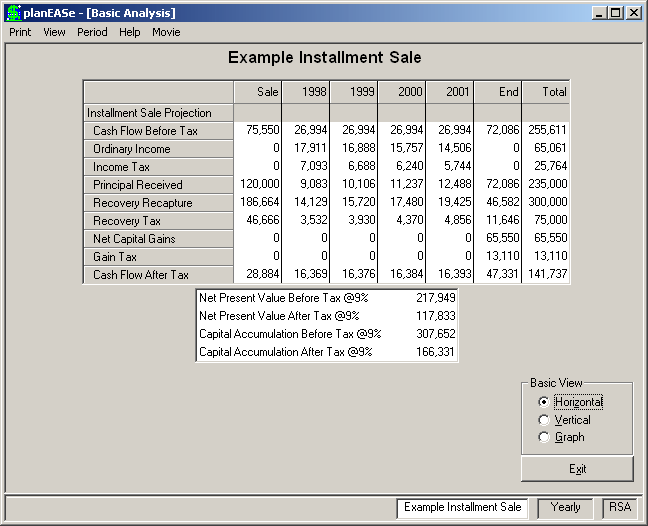
This projection (accessible from the Analysis / Basic menu option or the Basic button) shows the before and after tax cash flows associated with the Installment Sale. If you have more than one loan in your Analysis (as we have here), the cash flows, interest expense and principal re- ceived is easily obtained by accessing the Analysis/Detail menu option or the Detail button at the Assumption Edit Screen.
Cash Flow Before Tax shows the Sale Proceeds Before Tax detailed in the Installment Sale Report at the time of Sale. The amounts following (after the Sale) show the Debt Service cash flows for the Loan(s) and the loan repayment(s) at the End.
Ordinary Income at Sale shows the Excess Cost Recovery less Expensed Sale Costs less Unamortized Loan Points less Loan Prepayment Penalties. Following the Sale, the amounts show the Interest Expense (and Amortized Points) for the Loan(s).
Income Tax is simply Ordinary Income times the Tax Rate.
Principal Received at Sale is the Down Payment received as computed in the Installment Sale Report plus any Excess Mortgage over Basis. The amounts in following years represent the net principal payments on the loans in the analysis.
Recovery Recapture is the Principal Received times the Gross Profit Ratio computed in the Installment Sale Report, until all the Cost Recovery has been recaptured. If tax is paid Pro Rata this is the Principal Received times the Recovery Ratio computed in the Installment Sale Report.
Recovery Tax is the Recovery Recapture times the Cost Recovery Recapture Rate.
Net Capital Gains is the Principal Received times the Gross Profit Ratio computed in the Installment Sale Report, once all the Cost Recovery has been recaptured. If tax is paid Pro Rata this is the Principal Received times the Profit Ratio computed in the Installment Sale Report.
Gain Tax is the Net Capital Gains times the Capital Gain Rate.
Cash Flow After Tax is the Cash Flow Before Tax less the Income Tax, Recovery Tax, and Gain Tax.
Net Present Value Before Tax is computed using the Present Value Discount Rate Before Tax you enter in the Assumption Set, and represents the Net Present Value of the Cash Flow Before Tax discounted at that rate. If you enter a zero discount rate, for instance, the Net Present Value Before Tax would be exactly the same as the total Cash Flow Before Tax.
Net Present Value After Tax is computed using the Present Value Discount Rate After Tax you enter in the Assumption Set, and represents the Net Present Value of the Cash Flow After Tax discounted at that rate. If you enter a zero discount rate, for instance, the Net Present Value After Tax would be exactly the same as the total Cash Flow After Tax. This value ($117,833 here) may be compared to the Net Present Value of other offers to select the most profitable offer.
Capital Accumulation Before Tax is computed using the Present Value Discount Rate Before Tax you enter in the Assumption Set, as the Reinvestment Rate and represents the Capital Accumulation of the Cash Flow Before Tax reinvested at that rate. If you enter a zero discount rate, for instance, the Capital Accumulation Before Tax would be exactly the same as the total Cash Flow Before Tax.
Capital Accumulation After Tax is computed using the Present Value Discount Rate After Tax you enter in the Assumption Set, as the Reinvestment Rate and represents the Capital Accumulation of the Cash Flow After Tax reinvested at that rate. If you enter a zero discount rate, for instance, the Capital Accumulation After Tax would be exactly the same as the total Cash Flow After Tax.