After Tax Cash Flow Projection
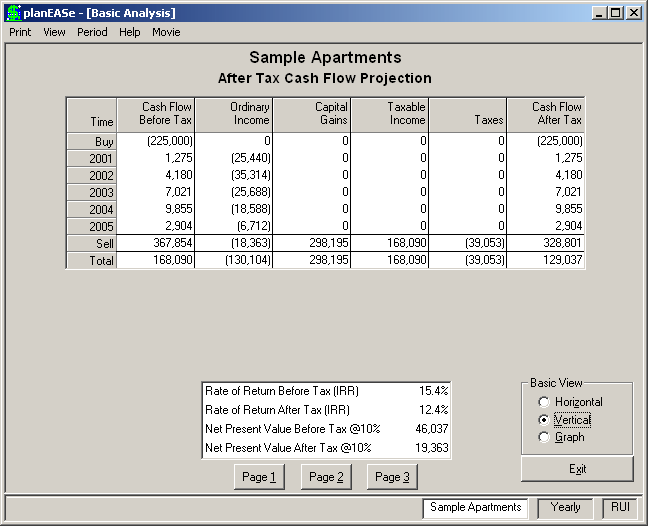
This page shows the after tax effect of the in- vestment. The purpose of this page is to analyze the attractiveness of the investment after tax. Additionally, this page gives you information which should be of use in tax and net worth planning.
Cash Flow Before Tax is the same as the final column on the first page of the analysis, shown here again for your con- venience in interpreting the results of the analy- sis. The Net Present Value and Rate of Return Before Tax is also shown again here for easy comparison of the before and after tax results.
Ordinary Income is the same as the final column on the second page of the analysis, shown here again for your convenience in interpreting the results of the analysis.
Capital Gains is the amount of the capital gain on the sale of the property. The amount of the gain is computed as the Net Sale Price less all additions to basis (this is the Total of the “Investment and Sale” column) plus the total of all depreciation taken for assets which add to basis (have a positive Depreciable Life specified). Thus any amortization schedules which have a negative life specified (and therefore do not add to basis) do not affect the gain even though the amortization amounts are included in the depreciation column.
Taxable Income is the sum of the allowable Ordinary Income and the Capital Gain. In the Sample Apartments, the losses generated are not allowable due to the passive loss limitation, and they are therefore “carried forward” until there is taxable income available to offset them. This occurs at the projected sale, and all previous losses are taken at that time. Note that the total Taxable Income ($168,090) is the same as the total Cash Flow Before Tax. This is always true if no non-taxable revenues and expenses are in your Assumption Set.
Taxes shows the taxes paid, calculated at the rate entered for that year in the Assumption Set. In this case, due to the application of the Passive Loss provision, the only tax owed is at the sale in 2005, computed on the $298,195 Capital Gain less the Ordinary Income deductions available at sale, as detailed in the Sale Report (not shown here). When Investment Tax Credits are assumed, the Credits are subtracted from the Taxes in this column in the appropriate year.
Cash Flow After Tax is the sum of the Cash Flow Before Tax and the Taxes columns, and represents the money the investor keeps after taxes. The rate of return and net present value for this cash flow stream are shown on the lower portion of the page as the Rate of Return After Tax, and the Net Present Value After Tax.
Rate of Return After Tax (IRR) is 12.4% in this case. As you can see, the difference between the 15.5% IRR Before Tax and the 12.4% IRR After Tax is simply the payment of $39,053 in taxes at the sale of the property. As discussed in the Investor Assumption section, you may allow passive losses to flow through to Taxable Income by setting the Cost Recovery Recapture Rate assumption to a minus value. If you do so in this case, you will find that the IRR After Tax improves to 14.4%.
Net Present Value After Tax is $19,363, meaning that you could afford to pay $19,363 more for this property and still obtain a 10% IRR After Tax.