Taxable Income Projection
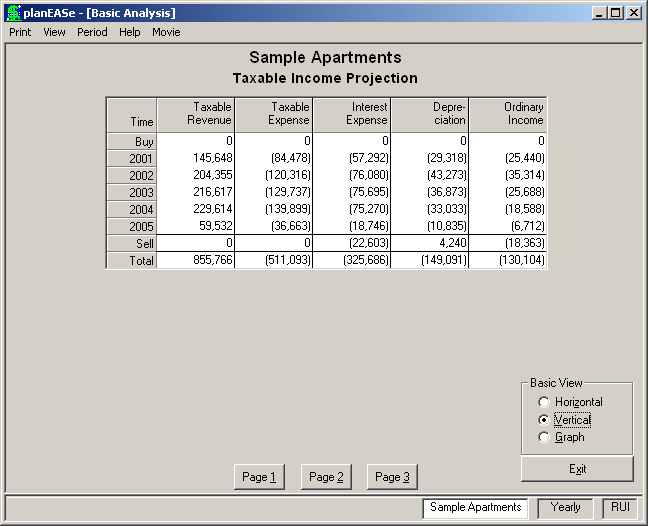
This page shows the details of the net income the investor would report for this investment for tax purposes.
Taxable Revenue in this case is the same as the Effective Income in the Before Tax Cash Flow Projection because the Assumptions call for all revenues to be taxable. If some revenues were entered as non-tax items, the amounts in this column would be lower by the amount of non-tax items.
Taxable Expense in this case is the same as the Operating Expense in the Before Tax Cash Flow Projection because the Assumptions call for all expenses to be taxable. If some expenses were entered as non-tax items, the amounts in this column would be lower by the amount of non-tax items.
Interest Payments represents the portion of debt service which is interest as opposed to return of equity. This amount declines annually since more of the payment for the $600,000 mortgage is return of equity as the outstanding principal declines. The $22,603 in 2005 at the sale is the amount of the prepayment penalty paid at that time. If any points had been charged for the loans, the charge would be shown in this column in the Buy line if they were not amortized. If the points were amortized, they would be added to the interest payments shown here over the life of the loan. Any points not amortized at the end of the holding period are expensed for tax purposes at the sale, and would show here as an addition to interest expense at the sale.
The total $325,686 in Interest Expense is the same as the total of the Debt Service in the Before Tax Cash Flow Projection . This is always true, but it’s not immediately obvious that it should be. Lenders give you the money borrowed at the start of the loan, and require that you repay that total principal over the life of the loan. Any other charges (such as interest, points, or prepayment penalties) are deductible as interest. Since the $800,000 principal is both received and repaid, it cancels out in total, and the total of Debt Service is always equal to the Interest Expense.
Depreciation is derived from the Depreciation Assumptions, and shows the total depreciation for all depreciation (and amortization) schedules. The annual depreciation for the building is $750,000 divided by 27.5 years, or $27,273. In the first year, according to the half month convention, 8.5 months of depreciation are allowed for a total building depreciation of $19,318 in 2001. The $50,000 double declining balance depreciation for the carpets is subject to the half year rule, giving $10,000 in 2001, $16,000 in 2002, $9,600 in 2003, et cetera. Adding the $19,318 for the building in 2001 to the $10,000 for the carpets gives the $29,318 shown for 2001. Likewise $27,273 plus $16,000 for 2002 gives the $43,273 shown for 2002.
Due to the use of the straight line method, no depreciation is recaptured for the building. However, use of the double declining method for the carpets causes $4,240 more depreciation to be taken over the four year
holding period than would have been taken by the straight line method. This amount is recaptured and shown as a positive amount of $4,240 in the Sell line.
Ordinary Income is simply the sum of the first four columns, and represents the amounts to be reported to the IRS as “Ordinary Income” for this investment. The term “Ordinary Income” is not common in the real estate business, but is well known to tax professionals as the IRS definition of income other than Capital Gains.