Investor’s Assumptions
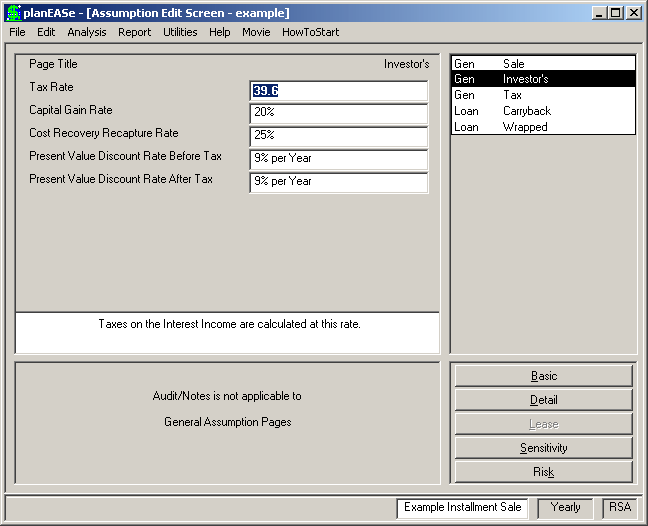
These assumptions describe the investor rather than the property itself.
The tax section in planEASe is merely meant to be representative of the results of the investment. For instance, the analysis does not account for crossing of tax brackets, or the possible applica- tion of the alternative minimum tax. The purpose of planEASe is to forecast the cash flows from, and tax liabilities of, investment real estate. If you are performing tax and/or financial planning for investors, that is properly the province of advisors in that area and/or tax planning soft- ware rather than this system. planEASe provides sufficient information in regards to the cash flows and tax consequences of the investment for input to such plans and/or software. The Individual Assumptions on this page are:
TAX RATE is the incremental rate at which the last dollar of the investor's current income is being taxed. In 2003, the maximum Federal Tax Rate was enacted at 35%. This tax rate can be combined with state tax to yield a combined rate. For instance, given a 35% Federal tax bracket for the investor, his California tax rate might be 11%. Since state taxes are deductible for federal tax purposes, his combined marginal tax rate would be 11% plus 35% of (100% minus 11%) or 42.15%.
CAPITAL GAIN RATE is used to compute the tax on the Capital Gain at sale (over and above the Recapture of Cost Recovery). In 2003, the Federal Capital Gain Rate for individuals was lowered to 15%. The corporate rate remains at 34-35%.
COST RECOVERY RECAPTURE RATE is the statutory tax rate applied at sale to the Cost Recovery (Depreciation) taken during the Holding Period. In 1997, this rate was created and enacted at 25% for Capital Gains incurred by Individuals. The corporate rate remains at 34-35%. It is applied to the smaller of the total Cost Recovery Taken and the total Capital Gain. That is, if the Capital Gain is smaller than the total Cost Recovery, the 25% rate entered here will be applied to the Capital Gain amount (and the 15% Capital Gain Rate becomes irrelevant).
PRESENT VALUE DISCOUNT RATE BEFORE TAX is the discount rate used to compute the Net Present Value Before Tax in the analysis. It is also used as the Reinvestment Rate for the Capital Accumulation Before Tax Measure.
PRESENT VALUE DISCOUNT RATE AFTER TAX is the discount rate used to compute the Net Present Value After Tax in the analysis. It is also used as the Reinvestment Rate for the Capital Accumulation After Tax Measure.