Tax Assumptions
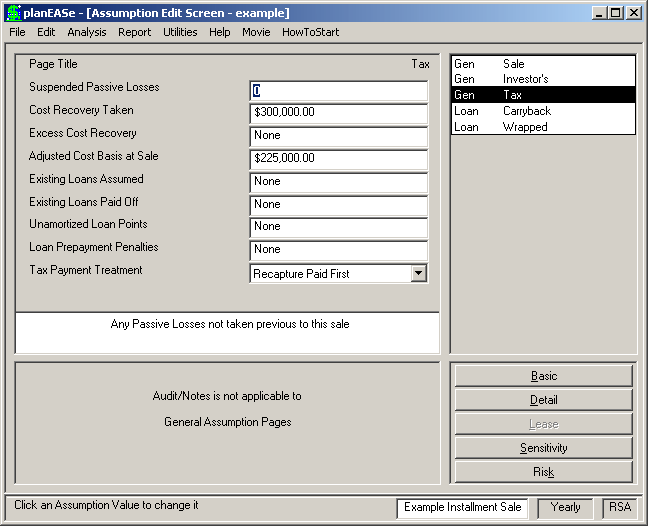
These assumptions deal with the tax information necessary to compute the Installment Sale Pro- jection and Installment Sale Report for the property. The individual assumptions on this page are:
SUSPENDED PASSIVE LOSSES is the total amount (if any) of Passive Losses on the prop- erty that have not been claimed against prior income and remain in suspension at the time of sale. Suspended Passive Losses are subtracted from the Capital Gain on sale to determine the Net Capital Gain that is subject to tax, as shown in the Sale Report and the Installment Sale Report.
COST RECOVERY TAKEN is the total Cost Recovery (Depreciation) taken (including any Excess Cost Recovery and any Prior Cost Recovery transferred to this property from an earlier 1031 Exchange) against this property. Excess Cost Recovery is subtracted from this Cost Recovery Taken to determine the Cost Recovery Recaptured in the Installment Sale Report.
EXCESS COST RECOVERY is, generally, any Cost Recovery (Depreciation) taken in excess of what could be taken under the Straight Line method. This typically occurs on older properties where Cost Recovery was taken under the ACRS Methods. If this is the case, and the property is not residential, the entire amount of Accelerated Cost Recovery taken under ACRS may be treated as excess. planEASe subtracts Excess Cost Recovery from Cost Recovery Taken to determine the Cost Recovery Recaptured in the Installment Sale Report. Excess Cost Recovery is taxed (at the time of sale) at the Tax Rate for ordinary income.
ADJUSTED COST BASIS AT SALE is the sum of the original Purchase Price (or other basis substituted due to a 1031 Exchange), plus any Closing Costs capitalized at the purchase, plus the cost of any improvements capitalized during the Holding Period, less the total Cost Recovery (Depreciation) taken during that Holding Period. Adjusted Cost Basis at Sale affects many of the calculations shown in the Installment Sale Report, and, hence, the Installment Sale Projection in the Installment Sale Analysis Model.
EXISTING LOANS ASSUMED is the balance(s) outstanding on any loans to be assumed by the buyer as part of the sale. Do not include the balance(s) of any loans to be “wrapped” as part of the sale. Wrapped loans are entered as normal planEASe loans (on Loan Pages) with negative loan amounts. Existing Loans Assumed affects the calculation of Mortgage over Basis.
EXISTING LOANS PAID OFF is the balance(s) outstanding on any loans to be paid off by the seller as part of the sale. Do not include the balance(s) of any loans to be “wrapped” as part of the sale. Wrapped loans are entered as normal planEASe loans (on Loan Pages) using negative loan amounts. Do not include any Loan Prepayment Penalties or Unamortized Loan Points for these loans... They are entered elsewhere on this Tax Page. Existing Loans Paid Off are subtracted from Sale Proceeds Before Tax in the Installment Sale Report and subtracted from the Cash Flow Before Tax in the Installment Sale Projection. Existing Loans Paid Off affect the Gross Profit Ratio, Profit Ratio and Recovery Ratio detailed in the Installment Sale Report.
UNAMORTIZED LOAN POINTS allows you to enter any Unamortized Loan Points on Existing Loans Paid Off by the seller at the sale and on any Existing Loans Assumed by the buyer at the sale. These unamortized points are written off (as Ordinary Income Deductions) at the time of the sale in the Installment Sale Projection, thereby causing decreased tax payments at that time.
TAX PAYMENT TREATMENT In February 1999, the IRS published Proposed Regulation 1.453-12 governing reporting of Installment Sales of Depreciable Realty, implementing the dual-rate treatment of Capital Gain under the Taxpayer Relief Act of 1997. This Proposed Regulation requires that the Cost Recovery Recapture portion of the gain (taxed at 25%) be paid first, before the remainder of the gain (taxed at 20%). An alternative treatment, preferred by the industry and taxpayers, is that both elements of the gain be paid ratably during the Sale Period.
This Tax Payment Treatment field provides you with the choice of using the Proposed Regulation (the default, named Recapture Paid First) or the fair treatment (named Recapture Paid Prorata) which may eventually prevail. Use this field to compare the effect of this proposed regulation, and choose either (or both) treatments to counsel your clients.