Sale Assumptions
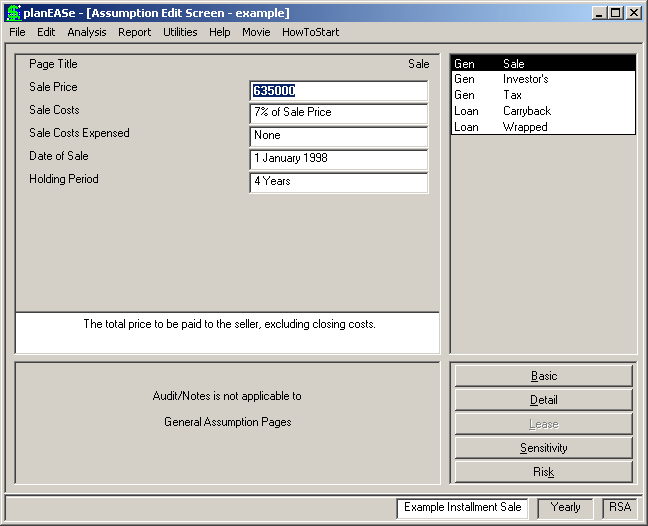
These assumptions control the time frame and the Sale Proceeds in the Installment Sale Projec- tion. The individual assumptions are:
SALE PRICE is the total amount the buyer paid for the property acquired on the Date of Sale, including balances on any loans assumed by buyer. Do not include any other costs, such as sale costs or loan points, which are entered elsewhere.
SALE COSTS are the costs of closing in escrow to be paid by the seller. Amounts of 100 or less are treated as a percent of the Sale Price, so a value of 2.5 entered here together with a $1,000,000 Sale Price would cause $25,000 of Sale Costs in the analysis. Loan points are included in the loan computations, and should not be included in these Sale Costs or you will double count them in the analysis.
SALE COSTS EXPENSED is the percent of the Sale Costs expensed for tax purposes. The remaining Sale Costs are subtracted from the Sale Price to determine Net Sale Price for capital gain computations, as shown in the Installment Sale Report. Amounts greater than 100 are treated as a dollar amount (which is limited to no more than the Sale Costs). Typically, all Sale Costs are capitalized (subtracted from the Sale Price), so you would normally enter zero here.
DATE OF SALE is the date the property is being sold, denoted as a planEASe Date. planEASe always presumes that the sale occurs on the first day of the month. The Holding Period and the Date of Sale together determine the time frame shown in all the projections.
HOLDING PERIOD is typically the number of years remaining in the loan(s) in the analysis. Since there can be more than one loan, and you may want to investigate the effect of the seller prepaying the loan, we provide the Holding Period to facilitate such analysis. Fractional years such as 4.75 are permitted. The minimum value is one year, and the maximum is 99 years. The Holding Period and the Date of Sale together determine the time frame shown in the Installment Sale Projection.