Investment Assumptions
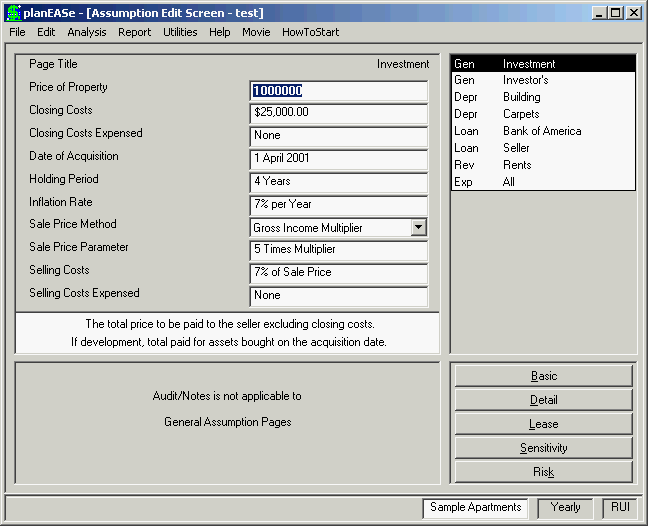
These assumptions deal with the purchase and subsequent sale of the property. The individual assumptions are:
PRICE OF PROPERTY is $1,000,000 for the Sample Apartments. If you are projecting a development project, this amount should only include the assets acquired on the Acquisition Date (typically just the land and existing im- provements). Any new improvements you project adding after the Date of Acquisition would be treated as Capital Spending with Depreciation Pages. Appraisers (and others) may want to leave this assumption as $0 here and use the computed Present Values to establish value (which may later be substituted back into this assumption).
Enter a “1” to make a Tenant Representation Assumption Set, and “2” for Owner Representation. See the tenant.ru and owner.ru Assumption Sets shipped with planEASe and the Lease Analysis description on page 32 for an example of this type of analysis.
CLOSING COSTS are the costs of closing in escrow ($25,000 for the Sample Apartments). Amounts of 100 or less are treated as a percent of the Price of Property, so a value of 2.5 entered here would have the same result as the example. Loan points are included in the loan computations, and should not be included in these closing costs or you will double count them in the analysis.
CLOSING COSTS EXPENSED is the percent of the closing costs expensed for tax purposes in the initial tax year of operations. In the example, none of the $25,000 are expensed. The remaining closing costs are added to the cost of the property to determine the tax basis for capital gain purposes. Amounts greater than 100 are treated as a dollar amount (which is limited to no more than the Closing Costs entered).
DATE OF ACQUISITION is the numerical month (1-12) and last two digits of the year in which the property is being acquired. The entered value of 4.01 for the Sample Apartments means the escrow closes on 1 April 2001. planEASe presumes that the acquisition occurs on the first day of the month.
HOLDING PERIOD is the number of years that the investor plans to hold the property before selling (four years for the Sample Apartments). Fractional years such as 4.75 are permitted. The minimum value is one year, and the maximum is 99 years.
INFLATION RATE is the annual inflation rate expected during the Holding Period (7% for the Sample Apartments). This assumption is used in conjunction with the assumed growth in expenses and revenues to project property income and expenses (and for sale price if you are using a Sale Price Method of Continuous Growth (%>Inflation)).
SALE PRICE METHOD is the method that you choose to compute the sale price. Each method (other than No Sale Price Computed) requires a Sale Price Parameter (described on the following page) to operate. The methods are:
Capitalize Current NOI computes sale price as a Net Capitalization Rate against the Gross Income less Operating Expenses (with subtraction of both vacancies and management fees) in effect at the time of sale. The Capitalization Rate is taken from the Sale Price Parameter, and is presumed to be an annual percentage. Thus if the Sale Price Parameter were 8, planEASe would compute sale price based on an 8% Net Capitalization Rate. While this method is the default, it should NOT be used for analysis of Multi-Tenant properties where you are using Market Profiles to plan the leases on expiration. Rather, you should use either of the next two Methods for such analyses.
Capitalize Last Year’s NOI computes sale price as a Net Capitalization Rate against the Gross Income less Operating Expenses (with subtraction of both vacancies and management fees) projected to occur during the 12 months prior to the projected sale. The Capitalization Rate is taken from the Sale Price Parameter, and is presumed to be an annual percentage. Thus if the Sale Price Parameter were 8, planEASe would compute sale price based on an 8% Net Capitalization Rate.
Capitalize Next Year’s NOI computes sale price as a Net Capitalization Rate against the Gross Income less Operating Expenses (with subtraction of both vacancies and management fees) projected to occur during the 12 months after the projected sale. The Capitalization Rate is taken from the Sale Price Parameter, and is presumed to be an annual percentage. Thus if the Sale Price Parameter were 8, planEASe would compute sale price based on an 8% Net Capitalization Rate.
Continuous Growth (@ Growth Rate) computes sale price based on an Annual Percentage Growth from a base of the purchase price entered. The percentage growth used is the Sale Price Parameter. In other words, this method is the same as the next method, with the exception that the Growth Rate is independent of the Inflation Rate.
Continuous Growth (@ %>Inflation) computes sale price based on an Annual Percentage Growth from a base of the purchase price entered. The percentage growth used is the Inflation Rate entered plus the value entered as the Sale Price Parameter. In other words, an Inflation Rate of 7% with a Sale Price Parameter of 1 would result in 8% annual growth in Sale Price from the original purchase price, and a Sale Price Parameter of -1 (minus 1) would result in 6% annual growth in the same situation. We use the Inflation Rate as the base to facilitate Sensitivity and Risk Analyses which name the Inflation Rate as an assumption. This means that the sale price is dependent on the Inflation Rate in such analyses, which is desirable in general. It also means that the sale price automatically changes in Basic Analysis when you change the Inflation Rate
Specified $ Price computes sale price as exactly the Dollar Amount you enter in the Sale Price Parameter. This option is provided as an “escape hatch” in case none of the other Sale Price Methods are appropriate for your particular analysis. You should use care in performing Sensitivity and Risk Analysis if you choose this method, since changes in the Holding Period, Revenues and Expenses associated with the analysis do not affect the sale price computed in this fashion. In most cases this is not realistic.
Net Cap Rate without Management Fee computes sale price as a Capitalization Rate against the Gross Income less Operating Expenses (with subtraction for vacancies but not management fees) in effect at the time of sale. This method is the same as Gross Capitalization Rate and Capitalize Current NOI, with the exception of the treatment of vacancies and management fee.
Gross Income Multiplier computes sale price with a Gross Income Multiplier against the Gross Income (without subtraction for vacancies) in effect at the time of sale. The Gross Income Multiplier is taken from
the Sale Price Parameter, so a Sale Price Parameter of 5 means a Gross Income Multiplier of 5 times the Gross Income. This method is used in the Sample Apartments Assumption Set, and the Gross Income Multiplier is taken from the Sale Price Parameter assumption value of 5.
Gross Capitalization Rate computes sale price with a Capitalization Rate against the Gross Income less Operating Expenses (without subtraction for vacancies or management fees) in effect at the time of sale. The Capitalization Rate is taken from the Sale Price Parameter, and is presumed to be an annual percentage. Thus if the Sale Price Parameter were 8, planEASe would compute sale price based on an 8% Gross Capitalization Rate.
No Sale Price Computed results in no sale price (i.e. $0), and the contents of the Sale Price Parameter are ignored.
For Sale Price Methods Gross Income Multiplier, Gross Capitalization Rate, Net Cap Rate without Management Fee, and Capitalize Current NOI, planEASe projects those items ON THE DAY OF SALE in computing sale price. If you have items of Revenue or Expense which are growing, that growth is therefore taken beyond the amounts shown for the last year (which are inflated to the middle of that year). This method of computation is used to allow for revenue and expense changes in the last part of the sale year. After all, if you raise the rents in October and sell in December, surely the sale price should reflect the October increase. If we computed based on the average revenues for the year or some other method, that increase would be largely ignored. If you are using Market Profiles to re-lease expiring space, we recommend that you use other Sale Price Methods to avoid having excess vacancies on the day of sale inappropriately affect the projected Sale Price.
Revenue and Expense Pages which end prior to the sale date or start after the sale date have no effect on the sale price (with the exception of Capitalize Next Year’s NOI, and Capitalize Last Year’s NOI which do take into account items starting within one year respectively before and after the projected sale). This makes obvious sense, but can cause unintended changes in the computed sale price when you change the Acquisition Date or the Holding Period assumptions in Basic, Sensitivity or Risk Analysis.
SALE PRICE PARAMETER operates together with the Sale Price Method to produce the projected sale price for the property. The Sale Price Method of Gross Income Multiplier for this property means that a Gross Income Multiplier will be used to compute sale price, so the value of 5 here means the user wants a Sale Price of 5 times Gross Income for the Sample Apartments.
SELLING COSTS is the percent of the sale price which must be paid by the investor as closing costs at the time of sale, including all commissions and other closing costs such as Title Insurance, etc (7% for the Sample Apartments). A value greater than 100 is treated as a dollar amount for selling costs.
SELLING COSTS EXPENSED is the percent of the selling costs to be expensed for tax purposes (0% for the Sample Apartments). The remaining closing costs are subtracted from the selling price to compute the capital gain on the sale of the property.